

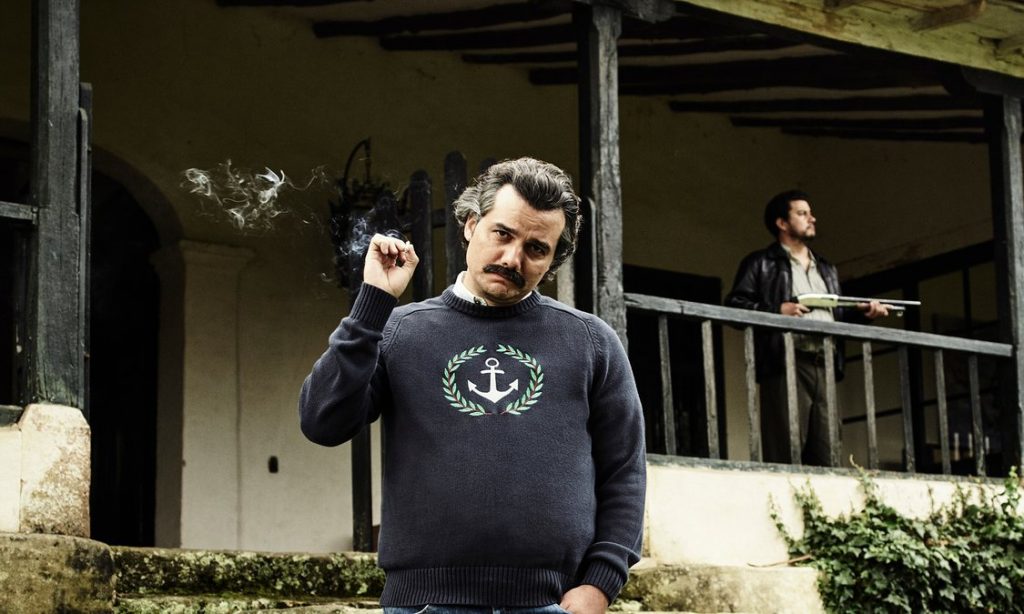
Terror knows no bounds. It is a universal language that has unfortunately seeped into every society in recent years to devastating effects. It is a tool of intimidation; a leverage-grabbing exercise; a heinous, yet ultimately effective method of communication that mobilises the masses. One can’t underestimate its impact or the important role that it’s played in shaping our current lives as we know them. Indeed, 15 years after the obnoxious horror generated by the 9/11 attacks, terror in its various forms is being examined with meticulous attention in two of TV’s biggest and most influential projects, Mr. Robot and Narcos; the results have been spellbinding to say the very least. In a world that is sadly well versed in the monstrous aftermath of countless terror attacks, both shows have somehow done a remarkable job of bringing new elements to the gloomy, ‘last supper’-like table through enchanting forays into the minds of two of TV’s most conflicted characters, the dramatised Pablo Escobar and the hopelessly troubled Elliott Alderson.
At its purest appalling form, terrorism is an appeal for change. It is mostly utilised when most other means for radical change have been exhausted to limited effect. It seeks to introduce anarchy into a world that is mostly too rigid and too bound by the various institutions that hold virtually all the cards. Terrorism scares people into action by threatening their lives, both literally and figuratively. In Mr. Robot, last season’s insanely thrilling look at society’s truest backbones has been maneuvered into an equally enchanting look at an anonymous terror that is equally real and grotesque in the show’s ongoing second season. After last season’s hack of the all-powerful global conglomerate, E Corp, the show has chosen to engulf its post-revolution setting with a mystifying cloud of uncertainty that has caused fear and distrust to run amok in New York City in specific, and the world as a whole.
With authorities working vigorously to capture the hack’s main perpetrators, Mr. Robot has illustrated that dread and terror have as much to do with confusion and disenchantment as much as they do with explosions or random killings. In fact, the show’s mysterious and all-powerful Dark Army relies on just that. They’ve levied clandestine intimidation and beneath the covers influence to arguably become the world’s most powerful group; that’s without even getting into the calculated trepidation continuously exuded by their mysterious leader, White Rose, in all of her different iterations.
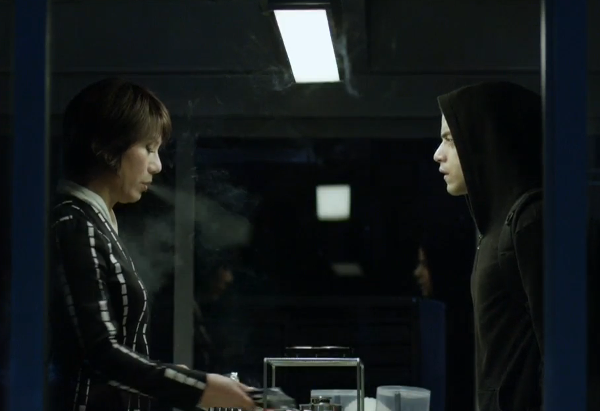
Mr. Robot has showed that terror is a weapon onto its own. It doesn’t have to be about killing people by the hundreds; it achieves a similar impact when there’s a mere implication of endangering people’s livelihood if need be. It’s about the thought as much as it’s about the action. And that’s where the show succeeds the most. Its intelligence lies in understanding the impact that isolated, individual bubbles have on the way that people act or react. Everything that we experience, every emotion that we feel and every situation that we find ourselves in are all in our minds; that’s where terror is most effective, in an abstract, isolated turf in our heads that can’t quite comprehend the dangers out there. There’s an unmatched power in subtlety. Mr. Robot has shown us that there is nothing more terrorising than that specific nous. Don’t tell that to the pragmatists, though.
Indeed, one man who never really cared much for subtlety was one of the world’s most notorious terrorists during the 1980s and 90s. Colombian drug-lord Pablo Escobar was blatant in his use of terror tactics during his continuous conflict with authorities in his lifetime. From car and plane bombings to routine police killings to destruction of government buildings, Escobar did it all. It’s no wonder that Narcos, a show devoted to his life through its deeply engrossing two seasons, has become such an enormous hit with audiences from all over the globe. At the core of its success has been its admirable humanisation, so to speak, of Escobar at the height of his madness. The monstrosities committed by the Escobar-led Medellin Cartel were just an effort to remain in power and take what they want in life in the only way they really knew how to live.
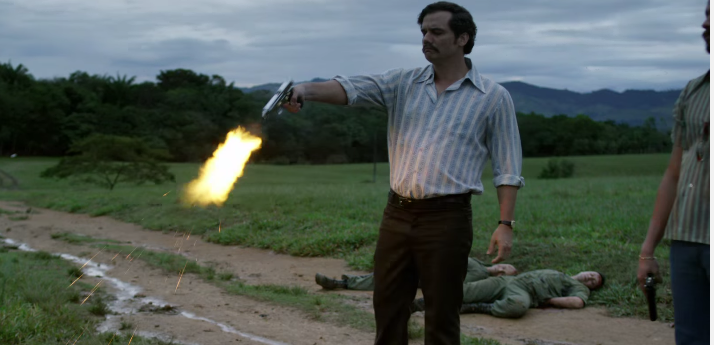
Narcos doesn’t condone their terroristic attacks on the government. Contrarily, the show illustrates that these attacks, if anything, only served to minimise the power of Escobar and his associates. While terrorism allowed them to get back at their enemies, it also robbed them of the average joe’s support, one that was so key to their rise to power in the first place. The Medellin Cartel failed to comprehend that every action brews a reaction. Instead of biding their time and waiting for an opportunity to hit back to arise, they resorted to killing innocent bystanders just to prove a point. There’s no wonder they lost their empire almost as quickly as they built it. Without trying to disguise their terroristic goals, there was nothing to save Escobar and co from the wrath of Colombia.
Narcos shows us that terrorism is both a direct byproduct and cause of violence escalation. In other words, terrorism doesn’t just arise from magnified violence; it intensifies it even further. More importantly, terror’s impact is so great and flexible that it could even be used as a negotiating ploy in any power conflict. It’s a testament to his intelligence that Escobar managed to use it better than most. It’s no surprise, however, that this later on turned out to be the straw that broke his back. Terrorism is nothing if not a double edged sword. Its sheer volatility and the impact that it has on innocent bystanders completely throws all supposed combat rules out the window.
We thankfully haven’t gotten there on a global scale yet. Nevertheless, terrorism’s impact on our lives hasn’t waned one bit since 9/11’s ugliness 15 years ago. It’s thus been very refreshing to see both shows dive headfirst into the thornily dark topic, and present enchanting viewpoints to boot. The representations shown by Mr. Robot and Narcos indicate that a cloud of mystery allows fear to settle in and shimmer, while tangible brutality leaves no choice for itself but to be countered with equal force. In that scope, we were not only reminded of the sheer panic that implanting fear into people causes, but also of how human terrorists really are, whether we’d like to admit it or not. It is really all in the mind. Its intangibility is what makes it so dangerous.