

Some might say that Jumana Mourad is enjoying the most remarkable chapter of her career today. But anyone who has followed her work over the past three decades knows that she has never stopped evolving. Since making her screen debut in 1998 with the Syrian television series Baqaya Sowar (Remnants of Images), Mourad has built one of the Arab world’s most enduring careers, effortlessly crossing from Syrian to Egyptian television and cinema to become one of the region’s most celebrated leading actresses. Whether audiences first watched her win over Egyptian audiences in Qalb Habiba (Habiba’s Heart), discovered her through the iconic Syrian series Bab El Hara (The Neighbourhood’s Gate), or admired her career-defining performances in Cabaret and El Farah (The Wedding), she has spent nearly three decades proving that talent transcends borders. This year, however, audiences have seen another side of her. Her latest series, El Loon El Azrak (The Blue Colour), has sparked conversations across the Arab world, introducing a performance that resonated far beyond the screen. During a summer break on Egypt’s North Coast, her favourite escape, Enigma’s Farida Elserty chatted with the actress to talk about a career that continues to evolve, the role that touched thousands, embracing every stage of life with confidence, and the legacy she hopes to leave behind.
In The Blue Colour, Mourad plays a mother of a child with autism, delivering one of the most emotionally affecting performances of her career. Rather than focusing solely on the condition itself, the series shines a light on the often-overlooked emotional reality of the families living with it. Her portrayal resonated so deeply that the Egyptian Autism Society named her Autism Awareness Ambassador for 2026, while countless mothers reached out to tell her they finally felt seen, understood, and represented. “It’s not only about autism,” she says. “It’s about the families living through it every single day. We often focus on the diagnosis, but we forget the mothers, the fathers, and everyone carrying that journey with them. They deserve all the support in the world.”
When I reached her, Mourad was exactly where she’d rather be than almost anywhere else. Egypt’s North Coast has long been her favourite summer escape, and even over the phone she sounded relaxed, warm, and remarkably candid. It quickly became clear that The Blue Colour was never just another role. She spoke passionately about using the series to draw attention to the quiet resilience of parents whose lives revolve around caring for a child with autism. “The mothers are the real ambassadors,” she says, reflecting on the title she recently received. “They’re the ones who deserve all the recognition.”
Listening to her, it became easy to understand why audiences have remained invested in Mourad for so many years. Despite a career spanning blockbuster films, acclaimed television dramas, and countless accolades, there is little pretence about her. She speaks with the quiet assurance of someone who has long stopped trying to control every outcome. The career that made her one of the Arab world’s most celebrated actresses, she insists, was never part of a carefully orchestrated plan. “I never chased acting,” she tells me matter-of-factly. “I wanted to be a television presenter, and I actually worked as one at Ajman TV and other channels. But all my friends kept telling me, ‘No, you’re an actress.’ Then the opportunities came my way, so I took them, and thankfully I succeeded. It was simply meant to be.” To Mourad, acting was never a choice so much as a calling. Perhaps that explains the quiet confidence with which she has navigated an industry that rarely stands still.
With nearly three decades behind her, Mourad’s perspective has inevitably shifted. These days, she speaks less about success than about growth, less about fame than about the lessons that come with experience. Looking back, she doesn’t dwell on missed opportunities or defining milestones. Instead, she returns to one lesson she wishes she had learned sooner: patience. “If I could tell my younger self one thing,” she says, her voice softening, “it would be to slow down.”
It’s a sentiment that feels surprisingly universal. “When you’re young, you’re always in a hurry,” she continues. “As we grow older, our choices become wiser. Sometimes I wish I had the mindset I have today when I was twenty. But that’s life. Every stage has its own beauty and its own lessons. We learn through our mistakes. If we’d already had this wisdom back then, we wouldn’t have made mistakes, and we wouldn’t have learned anything.”
That philosophy doesn’t just shape how Mourad approaches life; it informs the way she approaches every role. Over the years, she has become known for performances marked by emotional honesty, yet she insists that the real work begins long before the cameras start rolling. “I can’t play a role unless I genuinely love it,” she explains. “Whether the character is good or evil, I have to understand what motivates them. I spend a lot of time analysing every role. I create an entire backstory, even if it isn’t written in the script, because I need to live with the character before the audience can believe me.”
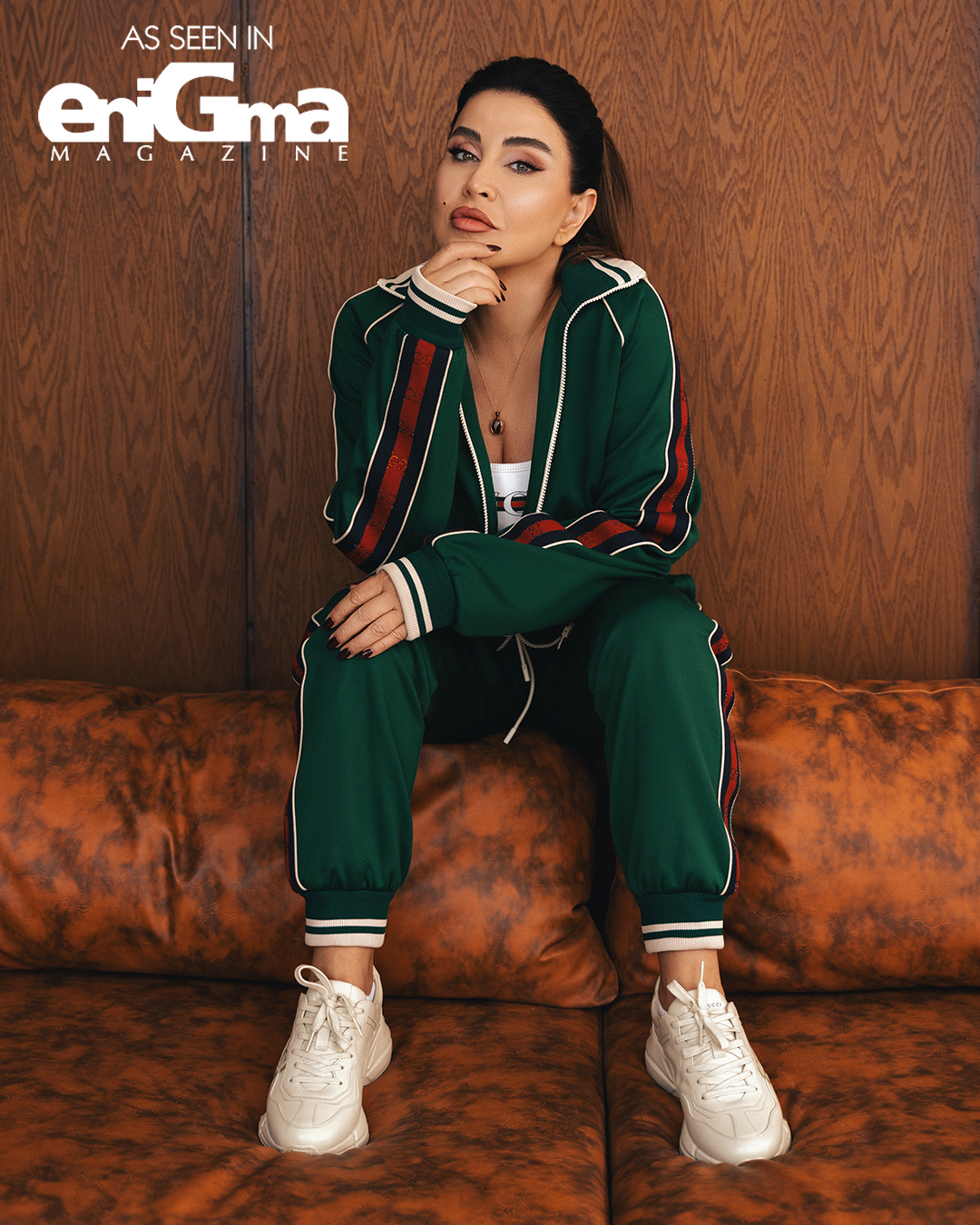
For someone who never set out to become an actress, Mourad speaks about her craft with remarkable conviction. Success, she believes, isn’t measured by the number of roles you play, but by the ones that challenge you. After all these years, she is still drawn to the unfamiliar, always searching for characters that push her somewhere she hasn’t been before. “I have to love the role,” she says without hesitation. For Mourad, that means looking beyond the character alone. The script, the world it creates, and the emotional truth of the story matter just as much as the part she is being asked to play. “I don’t want to play a predictable character,” she explains. “I want something unusual, something I’ve never done before. The entire script has to be strong. The whole project has to be well-crafted, and the role has to excite me artistically.”
Perhaps that’s why, when I ask whether there’s still a dream role left to play, her answer comes without hesitation. “Anything I haven’t done yet,” she laughs. “The most exciting roles are the ones that make you wonder whether you can actually pull them off. Egypt and the Arab world are full of extraordinary stories, and there are still so many waiting to be told.”
That sense of perspective extends well beyond the screen. Despite the spotlight, Mourad has never viewed fame as something to escape. Instead, she sees it as a privilege, one that comes with responsibility. “Honestly, I love fame,” she admits. “It’s a blessing. But what matters most is the love of the audience. That’s what gives you longevity and motivates you to keep improving.”
Yet while thousands follow her every move, she has always been deliberate about protecting the parts of her life that matter most. Her family remains firmly outside the public eye, preserving a space that belongs only to those closest to her.
If nearly thirty years in the industry have taught her anything, it’s that resilience is forged through life’s most difficult moments. She speaks openly about faith, patience, and the importance of trusting that every challenge carries a lesson. “Life doesn’t end because one difficult thing happens,” she says. “It keeps moving. You have to stay strong, stay hopeful, and trust that God’s plan is always better.”
That outlook also shapes the way she views success. For Mourad, great work doesn’t always receive the recognition it deserves. Timing, distribution, and circumstance can be just as decisive as the performance itself. “There are many projects that were unfairly overlooked,” she says. “Some would have received the recognition they deserved if they’d had a better release or reached a wider audience. That happens to all of us.”
Yet when I ask whether there’s one role she’d happily revisit, her answer comes without a moment’s hesitation. “Marassi in Baba El Magal (Godfather of the Field),” she says, laughing. The eccentric fan favourite clearly still holds a special place in her heart.
“People always remind me of her, and she’s completely different from who I am in real life,” Mourad says. “If I played her again, I’d push the comedy even further. She’s full of proverbs, obsessed with herself, slightly crazy, a bit psycho in her own way.” It’s easy to see why the character remains so memorable. Marassi is everything Mourad looks for in a role: unpredictable, larger than life, and impossible to forget.
As our conversation draws to a close, another theme begins to emerge. For all the success she has enjoyed, Mourad speaks far more often about what comes after it than the accolades themselves. Legacy, for her, isn’t measured in awards or headlines, but in the work that endures and the people it continues to touch. Becoming a mother has only deepened that perspective. “Since becoming a mother, I’ve wanted to leave behind work that lasts,” she says. “I’m proud to have been part of films like Cabaret and El Farah. I believe they’re among the landmark films of Egyptian cinema. I hope to make more work that people will continue to remember for years to come, and that one day my children can proudly say, ‘Our mum made those wonderful films.’”
Motherhood, she admits, has changed her in ways she never imagined. It has made her calmer, more patient and, perhaps most unexpectedly, more vulnerable. “I was never afraid before,” she says thoughtfully. “Now I am.”
When I ask her to describe herself in a single word, she laughs before admitting it’s the hardest question I’ve asked all day. “I’m very easy-going,” she says, only to immediately undermine her own answer. “My friends always laugh and say, ‘Easy-going? You’re the most difficult person on the planet!’” After a moment, she settles on two qualities she knows to be true. “I’m very affectionate… and extremely ambitious. My ambition has no limits.”
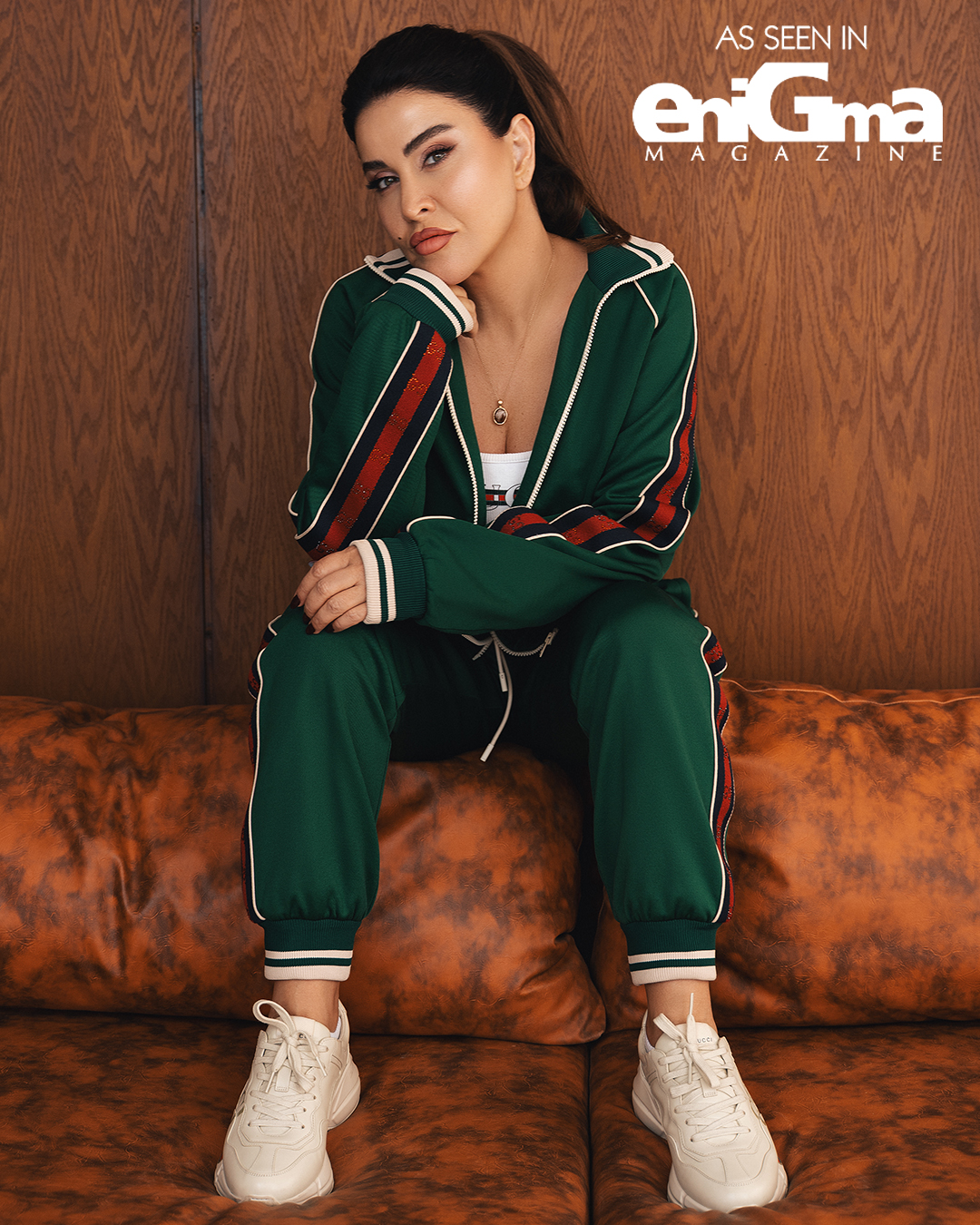
That ambition is balanced by a playful side that audiences rarely get to see. When I mention her sense of humour, her voice lights up. “Everyone who knows me says that,” she laughs. “I actually think I’d be good at comedy. I agreed and I told her that it would be great because people often assume beautiful women aren’t funny. “True. I honestly don’t know why. Some of the funniest people I’ve ever met have been beautiful women,” she asserts.
For now, though, she’s already looking ahead. While remaining tight-lipped about her next project, she confirms she’ll return for Ramadan with something entirely unexpected. “It’ll be completely different from The Blue Colour,” she says. “Different in every way: the look, the performance, the subject matter… everything. Hopefully people will enjoy it.”
After nearly three decades in the spotlight, Jumana Mourad continues to do what she has always done best: surprise her audience. If our conversation is any indication, she’s nowhere near finished writing the next chapter of her story.
Enigma Questionnaire:
If your life were a film, what would its title be?
Certainty.
Describe yourself in three words.
I need books!
What’s your zodiac sign?
Aries.
Tell us one director you dream of working with.
Martin Scorsese.
Do you prefer films or TV dramas?
I love both, but I definitely prefer films.
If you weren’t an actress, what would you be?
An actress.
What’s your favourite place?
The sea. I love sitting by the sea, and I wish I could live by it.
Summer or winter?
Oh, I’m definitely a summer person. I always say I wish we could live like this all year round in the North Coast. I absolutely adore it.
Has the North Coast become more difficult since becoming a mother?
No, it’s become even better. Everything in life has become better.
Creative Direction & Photography: Mohamed Salama
Styling: Hassan Essam
Project Manager: Rahma Yossri
Production Manager: Hussam Hassan
Assistant Photographer: Yasmen Ayman
Retouching: Luma Retouch
Location: C Studio