

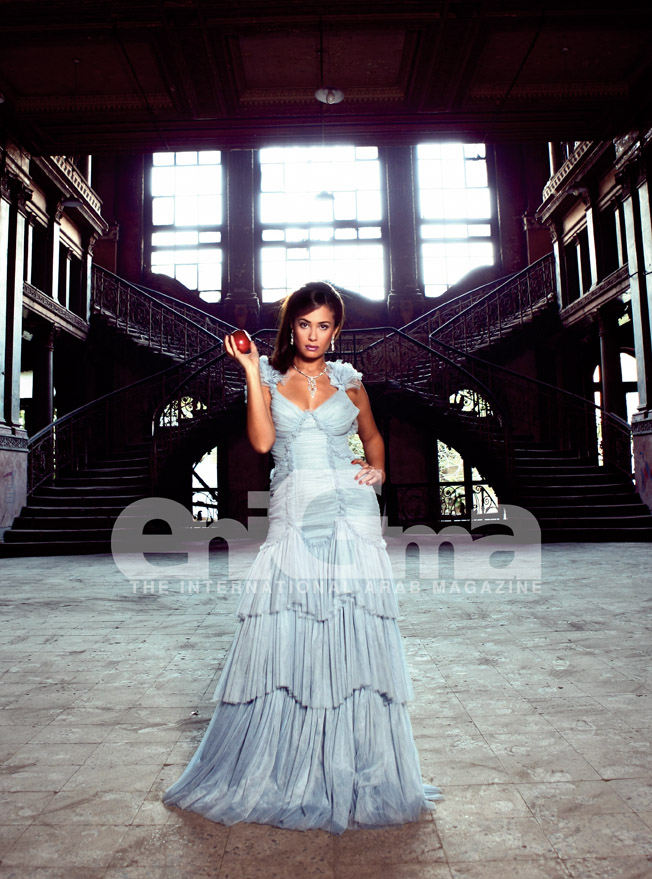
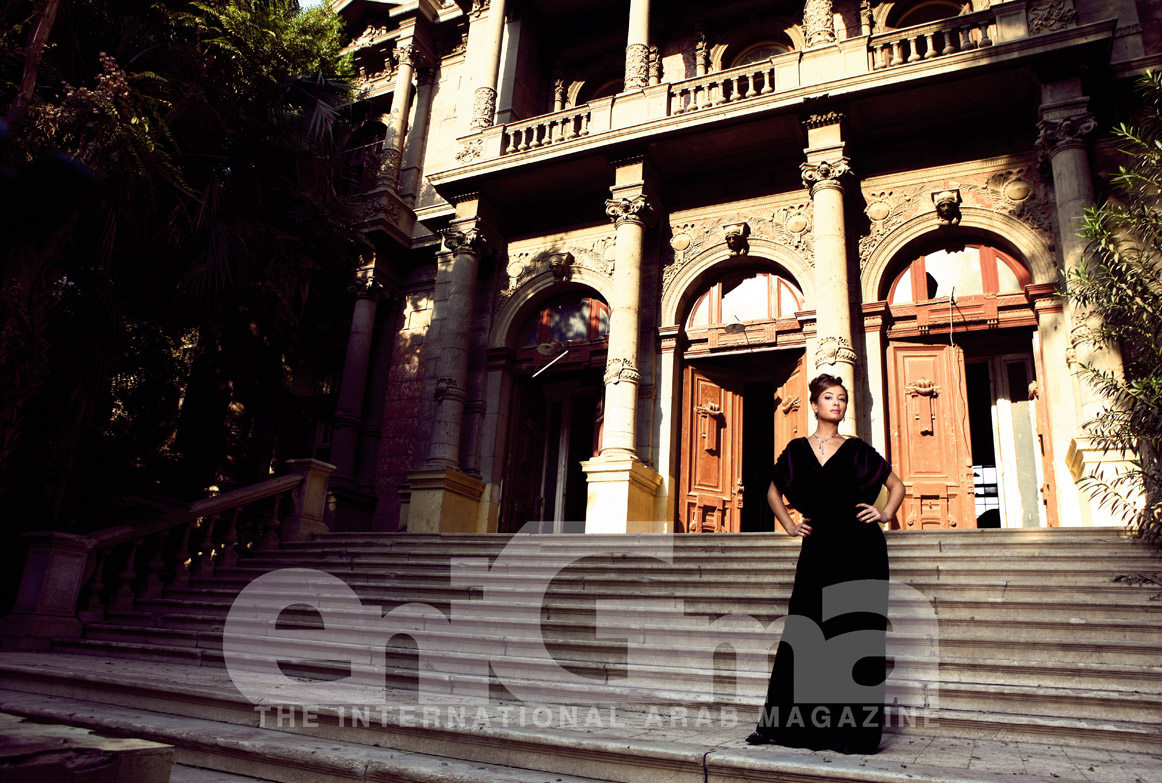
Hend Sabry epitomizes glamour. Her grace, style and elegance have made her one of the most sought after stars of her generation. She represents the new Arab woman; full of confidence, daring and ambition. In this Enigma exclusive, Dagher El Sakr gives us a glimpse at the real Hend Sabry, while Fashion Director Maissa Azab unleashes the glamazon inside this sulltry superstar.
end Sabry, the film star has graced the pages of Enigma on several previous occasions. Today, however, we are trying to have an audience with Hend as the woman, the wife, the person. This may prove tricky as it would require her to step out of the limelight, leave minders behind, and shed layers of makeup; both physical and otherwise – a task most Egyptian stars would have difficulty accepting, let alone managing without considerable headache. But our start is promising as Hend suggests a public place by the Nile in Zamalek for a late lunch meeting.
Hend’s beginning has been charted before, but I am keen to find out if she’s ever had a “regular” job. The answer is a resounding no. “I have a Master’s degree in law but I never practiced it.” When asked if she was ever tempted into trying it out, Hend answers by steering the conversation towards her current vocation. She explains, “I have a beautiful job but it is a bumpy one. It is not safe and there is nothing in it I can take for granted; so it’s good to know I have an alternative.” Having said that she confirms what we already know.
When asked if she missed out on normal teenage years because of her early success, Hend tells me becoming a child star at 14 years-old, while still at school, led to some unexpected problems. Instead of becoming the popular girl in her class, she was ostracised and made fun of. “I was turned into the school mascot and in the cruelest way possible. Having missed a lot of school because of acting, I soon became an outsider. That along with the actual acting job turned me into an adult while still a young teenager. I had no choice but to mature quickly.”
And now, less than a decade since she was last in her teens, does she have any regrets? After a long pensive pause, Hend finally says, “No. I would have been happy not acting, say being a lawyer, but I can’t tell you for sure because this life is all I have ever known. I have nothing to compare it to nor an alternative from my past to contemplate. There are times when I am tempted to try an alternative, but I am scared to take those steps.” Hend continues with a revelation that is shocking not in its content but its honesty. “Sometimes I want to try the alternative but I’m scared. At 23 or 24 I could have changed my career, but now at 29 I don’t know if I can. There is a certain comfort to this lifestyle; certain privileges, not least of which is the glamour that comes with it. I am not sure if I can give that up.” Yet Hend quickly adds, “Although I would like to believe that I can.”
So is she scared to not be taken seriously in another “job” and live without the fame? She replies, “If I tried to practice law I probably would not be taken too seriously at first, but I would persist until I proved myself. I am very good at it. I was always top of my class. I love the idea of order and the logic behind law. Any law, be it laws of marriage, property or any other type.”
And on the subject of fame, she adds “Fame is addictive, and not always in a good way. Of course it is gratifying being smiled at by total strangers on the street, especially in Egypt where people are genuinely kind and happy to tell you they like your work. But fame also has many pitfalls, like a complete lack of privacy and constant rumors that surround you and dictate your every action. Still at the same time it is intoxicating and highly addictive.”
The revelations continue, “I want to open up to other alternatives that would not necessarily take me away from the life I know. And I am trying, but it takes a lot of guts.” Quizzed for examples, Hend tells me about a documentary film project she has been writing for the last year, apparently only the beginning of what she considers an important and long learning process. And when asked why she’s spending years learning about the art of documentary when motion pictures are now second (or indeed first) nature to her, she quips, “The Arab world needs more reality and truth than it does fiction. My opus finale will be to define the Arab identity.” When asked if such a thing as common Arab identity really exists, she lets loose a telling mischievous smile and says, “Yeah, maybe that’s it, but perhaps not.”
I suggest a break from the formal questions, only because it is hard to type and eat at the same time, and so I casually ask her why she came to Egypt in the first place when at the time (about ten years ago), Egyptian cinema was suffering from a distinct lack in quality. That time was the Henedi heyday after all. The truthfulness of her answer inconveniently sends me back to the laptop. She says, “First don’t forget it was a coincidence. A director, whom I had not heard of, offered me a role in Egypt. It was summer and I had nothing to do, so I thought why not? It could be fun for a few weeks. But after finishing the film I had to make a choice; either go back to Tunisia, become a lawyer and perhaps make a film every three or four years or stay here in Cairo and become a full-fledged actress. At age 20, I thought being a lawyer could wait a few years and so I should not waste this opportunity. My age afforded me to give it a shot, but I never imagined, let alone planned, that I would live in Egypt for the past ten years, and indeed get married and start a family here.” Her answer leaves me unsatisfied so I stress the point further about Egyptian cinema at the time being devoid of any artistic quality, so how could she consider herself an artist here when back home in Tunisia, their films, as few and far apart as they may be, are considered among the most critically-acclaimed films in the region? Finally she admits, “I wanted a larger base, I wanted more people to see my films.” Then she adds a redeeming twist, “Egypt is the leader in Arabic media and to come here and try to make little changes allows me to have more far-reaching effects than I would have had in Tunisia.” So she wants to bring down the system from within, or at least change it considerably. A sentiment I’m all too familiar with, having written on and off about Cairo’s finest for Enigma throughout the past ten years.
And having gained local success and acceptance among her
Egyptian colleagues, does she have any favourites? Hend quickly slips into film star mode and says, “They have all been wonderful colleagues
and co-stars.” She does however prefer to work with the older generation. “Most of them did not become famous overnight and therefore
do not have large egos. Adel Imam for instance is one of the
best listeners I have worked with.”
And speaking of egos, I ask Hend about her most underrated quality. She says, “A lot of qualities; mostly my ego. I believe in myself. But I do not really belong in this industry. So I believe in my qualities outside of this profession. I am very kind, for example, but I cannot afford too much kindness in my line of work, so I must separate the two. I will not show the real me until I feel 100 percent safe and comfortable with someone. And in this profession that rarely happens.”
And so does she advise caution to any budding actresses out there trying to break into the industry? “My advice is that you will only succeed if your mind is framed in the right manner. You must read a lot, travel a lot, talk a lot and learn to see the world through many different eyes. You must become a sponge. Otherwise you will not be true to your art.”
 The revelations continue, “I want to open up to other alternatives that would not necessarily take me away from the life I know. And I am trying, but it takes a lot of guts.” Quizzed for examples, Hend tells me about a documentary film project she has been writing for the last year, apparently only the beginning of what she considers an important and long learning process. And when asked why she’s spending years learning about the art of documentary when motion pictures are now second (or indeed first) nature to her, she quips, “The Arab world needs more reality and truth than it does fiction. My opus finale will be to define the Arab identity.” When asked if such a thing as common Arab identity really exists, she lets loose a telling mischievous smile and says, “Yeah, maybe that’s it, but perhaps not.”
I suggest a break from the formal questions, only because it is hard to type and eat at the same time, and so I casually ask her why she came to Egypt in the first place when at the time (about ten years ago), Egyptian cinema was suffering from a distinct lack in quality. That time was the Henedi heyday after all. The truthfulness of her answer inconveniently sends me back to the laptop. She says, “First don’t forget it was a coincidence. A director, whom I had not heard of, offered me a role in Egypt. It was summer and I had nothing to do, so I thought why not? It could be fun for a few weeks. But after finishing the film I had to make a choice; either go back to Tunisia, become a lawyer and perhaps make a film every three or four years or stay here in Cairo and become a full-fledged actress. At age 20, I thought being a lawyer could wait a few years and so I should not waste this opportunity. My age afforded me to give it a shot, but I never imagined, let alone planned, that I would live in Egypt for the past ten years, and indeed get married and start a family here.” Her answer leaves me unsatisfied so I stress the point further about Egyptian cinema at the time being devoid of any artistic quality, so how could she consider herself an artist here when back home in Tunisia, their films, as few and far apart as they may be, are considered among the most critically-acclaimed films in the region? Finally she admits, “I wanted a larger base, I wanted more people to see my films.” Then she adds a redeeming twist, “Egypt is the leader in Arabic media and to come here and try to make little changes allows me to have more far-reaching effects than I would have had in Tunisia.” So she wants to bring down the system from within, or at least change it considerably. A sentiment I’m all too familiar with, having written on and off about Cairo’s finest for Enigma throughout the past ten years.
And having gained local success and acceptance among her
Egyptian colleagues, does she have any favourites? Hend quickly slips into film star mode and says, “They have all been wonderful colleagues
and co-stars.” She does however prefer to work with the older generation. “Most of them did not become famous overnight and therefore
do not have large egos. Adel Imam for instance is one of the
best listeners I have worked with.”
And speaking of egos, I ask Hend about her most underrated quality. She says, “A lot of qualities; mostly my ego. I believe in myself. But I do not really belong in this industry. So I believe in my qualities outside of this profession. I am very kind, for example, but I cannot afford too much kindness in my line of work, so I must separate the two. I will not show the real me until I feel 100 percent safe and comfortable with someone. And in this profession that rarely happens.”
And so does she advise caution to any budding actresses out there trying to break into the industry? “My advice is that you will only succeed if your mind is framed in the right manner. You must read a lot, travel a lot, talk a lot and learn to see the world through many different eyes. You must become a sponge. Otherwise you will not be true to your art.”
Hend’s advice is projected in the roles she plays on the silver screen; those of tough, independent-minded young women. She explains the attraction, “These are women that attract me on a personal level. Now that I am lucky enough to choose the roles I play, I want to dedicate my energy towards promoting the Arab woman the way I wish to see her. I want to promote the Arab woman who is liberal, but not in a typical Egyptian movie way where she has to drink, dance and sleep around. I want to promote the woman free to make up her own mind and make intelligent and educated decisions for herself, not just follow the paths chosen by her father, brother, or husband; women like my mother. In traditional cinema the role of women is either black or white. You are either conservative, passive and oh-so-very-adorable, or independent, tough and cruel (with a hint of prostitution thrown in to confirm the stereotype). Most Arab women I know are neither type. I want to put flesh on that role.”
Next, I remind Hend of something she said on these pages two years ago. She spoke at the time of reinventing herself, not with a new look, but a new direction in life. Recycling is what she called it. Has the time come for recycling? She smiles and says, “The career of a young actress is like that of a footballer, quite short; unless you become an icon like Yousra, which is extremely difficult and therefore quite admirable. But I cannot count on turning into an icon. So I want to go out on my own terms, when I’m still on top and while the audience still has a craving for me.” So in other words, does she want to go out in a blaze of glory? Apparently not. She says, “I would like to retire gracefully and slowly from film making, but it’s not very easy to do. Recycling is about using my name and fame to give back to the community. In the West, an actress like myself has a team; a PR manager, an agent, etc, who can help plan for a period of gradual retirement where an active community role can be put into action; be it charity work, or helping up-and-coming film makers. But here you are on your own, so you must do it alone and it could take years to plot that new path. It is just too vague and hard to figure out.”
Could recycling then simply be a move to France where surely a career in quality French cinema is not far-fetched? Hend is still in a candid mood and says, “I do have that choice but I would have to start from scratch, and I am not sure if I want to give up the life of a film star in order to audition for smaller roles of the pre-defined and stereotypical ‘Arab girl’ in Paris.” The addiction of being a star in France? Yes, but there is more to it than that apparently. She says, “They have a lot of people like me in Paris. But here I am needed. People like myself, Amr Waked, Mohamed Hefzy, and Marwan Hamed. Young educated people with a vision are needed.
Here we can make a difference and provide an alternative, albeit slight, to the norm. We try to make ‘artistic films’, along with those big productions. I would like to follow Johnny Depp’s pattern of ‘one for the big studios and one for me’. Last year I made El Gezirah (The Island), one of the biggest Egyptian productions so far, and at the same time I acted in Genenit El Asmak (The Fish Gardens), one of the smallest.” What Hend forgets to add, perhaps in modesty, is that unlike Pirates of the Caribbean 3, her ‘blockbuster’ was critically-acclaimed. So that’s one up on Mr. Depp for her to list.
So what then is she doing with herself when not shooting? Hend describes her current daily routine as the ‘Suburban Housewife’ (not the Desperate Housewife, she was careful to emphasize) phase. She is teaching herself yoga, spending afternoons lunching with girlfriends and watching movies at night with her husband Mohamed at their home just off the Cairo-Alex desert road.
A life too idyllic perhaps? Hend describes her life today as perfect. She is at peace, more than any other point in her life. “It is the fruit of three years of working on myself in a lot of ways, and now that I’m getting there it is really delicious.” Judging by how she looks today, I find that quite easy to believe. Hend is far more a beautiful person inside than she is a star.