
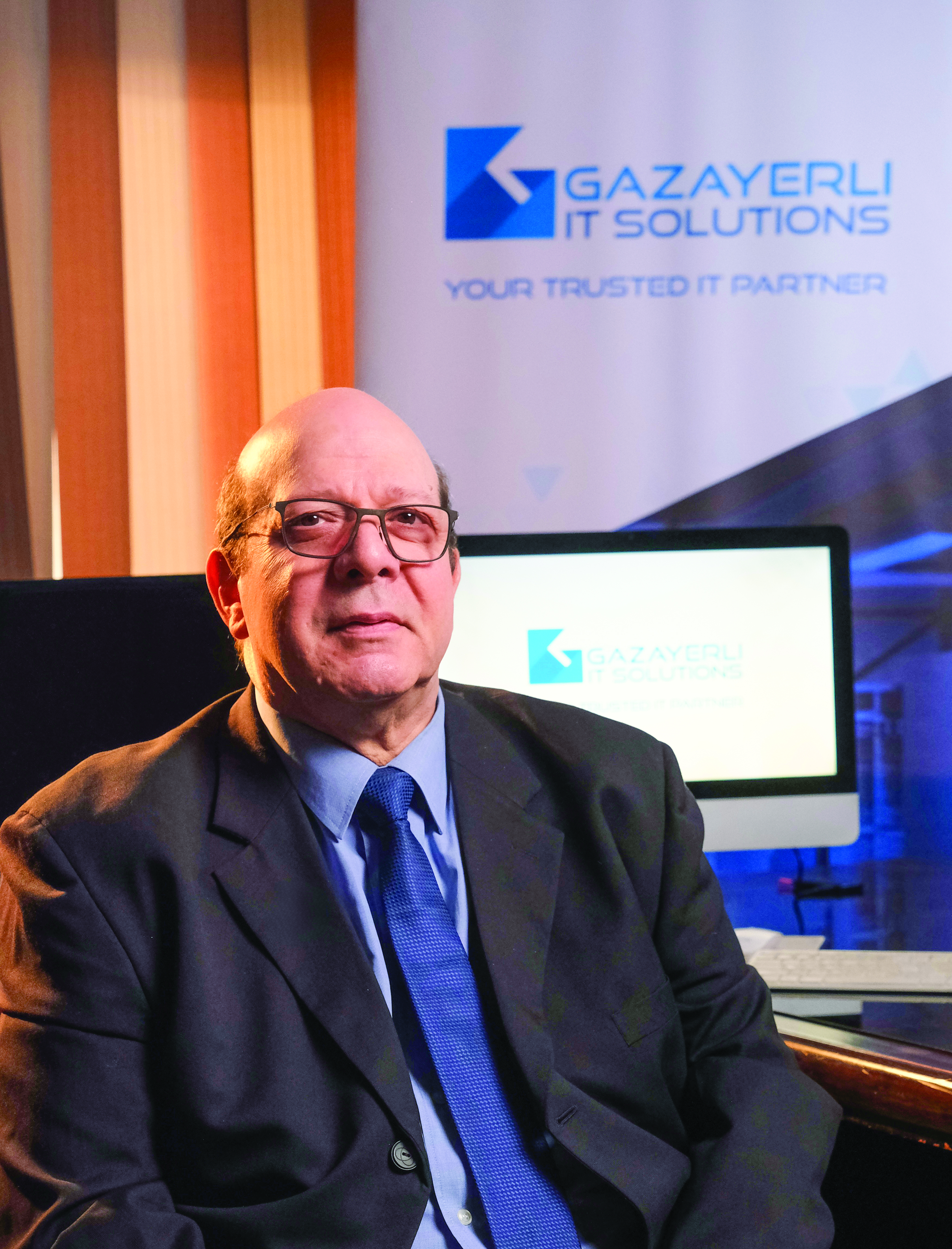
“No matter what we do, there are only 168 hours in a week,” says Aly Gazayerli. “I’ve tried for the last 66 years to increase them, and I couldn’t.” He taught himself to code more than 40 years ago, on a machine with just 1 kilobyte of memory. A businessman at heart, he has spent his hours since at the meeting point of commerce and computing: writing programs to make shipping containers carry the optimal load, betting on the internet while others were still sceptical, then founding Gazayerli IT Solutions. Today, his company serves law firms, factories, media agencies, real estate developers and financial institutions. Its products include GTMS, the Gazayerli Time Management System, a full legal practice management system built to international standards. In a one-off guest piece, his son, Tymour Gazayerli, took up 1 hour of his father’s 168 to look back on how he built the business, what he learned along the way and the advice he would give anyone starting out.
“I come from a family of physicians, but I was never interested in medicine. I was always fascinated by technology,” Gazayerli says. His first computer, the Sinclair ZX81, was a small British machine with a working memory of 1 kilobyte of RAM (a gigabyte is about a million times that). It plugged into a TV for a screen. There was no internal storage. “To save a programme, you would record it on cassette tapes and hear gibberish-like noise. That was your programme being saved as sound, and to run it again you would rewind the tape.”
He studied business administration at Alexandria University, which needed the least effort to learn without spending enormous amounts of time studying, while managing his family’s land and working in exports. Computer science was not what it is today, back then it meant mainframes and bulky machines, a long way from the personal computer that had caught his imagination.
While still at university, he exported live frogs, fresh frogs, and freshwater eels to Europe. “It was a wonderful experience but very tiring because it was mainly night-time work,” he says. Every other day, he drove a pick-up truck through his collection stations in the Delta and reached Cairo Airport between 1 – 2 am, while the plane left between 4 – 5 am. Then, it was back to Alexandria to shower, get the paperwork, go to the bank and university, before the whole process repeats. All the while, he was still managing his family’s land.
Technology stayed a passion on the side. “I couldn’t afford to buy mainframes and have my own mainframe computing business. But I believed using technology would revolutionise my work. I was passionate and started learning it myself,” he recalls. “My uncle was in maritime shipping. He had his own business, and he asked me to work with him. I started writing programmes to calculate how to maximise shipping containers: the optimal load, with the minimum wasted space.”
The logic was simple: “The cost of the container is the same whether you put one kilo or 20 tons, you’re still paying the same for the container. Every trip you save is profit.”
He worked there from 1979 to 1989. Those years also taught him valuable lessons. “My uncle taught me a lot, especially how to deal with different types of people, from the workers in the port to the CEOs of companies. My father taught me how to depend on myself.”
Then the clock was reset. “I got married and went to the United States for a honeymoon that lasted about 12 years.” When his wife’s father died during the visit, she became the backbone of her family. “It made sense to stay, we couldn’t just say, ‘Thank you, but we’re leaving,’” he says.
He kept shipping between the US and Egypt for a while, but at the same time, the computing age was evolving. When the internet arrived, he was sure of it. “In the very beginning, people were sceptical, but it didn’t take long to prove that they were wrong. Now there is nothing you can do without the internet.” He started a logistics company run on computers, and from there he went into technology and development.
“It wasn’t easy, though. Doing it alone meant very long hours of work and uncertainty. There was no regular steady income but I believe it was worth it,” he recalls. He began from a home office on his own, then hired freelancers, and when he moved back to Egypt, he started hiring employees. It took a certain attitude. “I’m opinionated, I’m stubborn, I’m strong-headed and I think that’s a perception people get when they don’t know me. Some of it may be true!”
I asked him if a leader needs those qualities? “Absolutely. Otherwise, you will break at the first challenge. But you always have to be willing to listen to the other side. There is nothing wrong with changing your mind if you find that what they’re saying makes sense.”
He has steered Gazayerli IT Solutions through Egypt’s swings of uncertainty in a market where the first line item to cut from a budget is IT expenditure. “What kept me going was the satisfaction of creating something new. That has always been a very big motivator, and that’s what allowed us to overcome any obstacles we faced.”
When Gazayerli is asked about what he does all day, he only talks about time. “It all comes down to how efficiently you can use your time. That’s something I learned at a very early age. You have something you want to do? Break it down to its smallest components and set a time for each step of the way, ideally 15 minutes each, and keep track of what you’ve done.”
Even his products come back to time. “Lawyers bill by the hour,” he says, so GTMS, the Gazayerli Time Management System, began as a way to track it, and “evolved into a full legal practice management system” built into international standards.
His clients range from legal firms, factories, snack makers, media agencies and jewellers to real estate developers and financial institutions. What they share is wanting complete control of their operations.
“Time is effort. If you know where your money is and what it’s doing, that’s the foundation of the business. If you know where you’re spending every pound, every piastre, every dollar and cent, then you have a pretty good knowledge of where your business is,” he says. “That’s what we help our clients with: proper financials, HR and accountability – any type of business. If you have that proper foundation and you’re serious about what you’re doing, you can have a successful business.”
His motto is “We do not take on clients; we take on partners.” How does that work, I asked. “We are not the type of company that makes a sale and runs away. We tell all our clients: we are your partners. We are here to stand by you and support you. We’re looking at their best interest, and their best interest becomes our best interest, because the more successful they are, the better off we are.”
He has watched the machines multiply. “Up until the late 80’s and early 90’s, one could know all existing computers, brands and models because there were very few. Today there is an infinite number of processors, brands and models that are evolving on almost a daily basis.”
AI is the latest leap. “There is no doubt that AI is very useful. It could be dangerous, but I believe AI is here, and it’s here to stay, and our clients are starting to realise its value.” His company builds it into its products and recommends AI tools to clients, depending on their industry.
AI shouldn’t replace the basics. “The problem, as I see it, is if you depend entirely on AI without knowing the basics, then you’re at the mercy of AI, whether it stops working or it decides to override you. That’s why I always tell my programmers in particular to learn the basics, learn what needs to be done, then use the tools.”
He measures success in “knowing that we’ve added real and meaningful value to our partners.” When asked about success beyond work, he says, “I think success is being satisfied with what you’re doing and content with the results. That you’ve done the best you can, helped people, helped businesses and been able to take care of and support your family and your friends.”
The cost was counted in hours. “I was busy working and not able to give my family the amount of time I should have. But it was required, especially when you’re starting something new from the ground up, on your own,” he says. “If I had to start over, I think I would do it again. I believe I have a pretty solid relationship with my family and my kids, I did the best I could for them, and I think they understand that.”
His advice for anyone taking the same leap is the method he has lived by. “Go for it. Do it, but study it properly. Make the effort, and always keep your goal in front of you. But, and this is crucial, divide your journey into the smallest steps, and document every step you take, so you know whether or not you’re heading in the right direction.” Then, to his son: “I believe I told you that before too.” He had.