

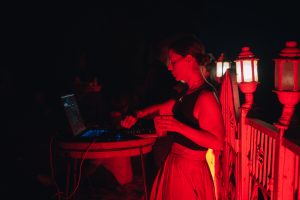
 People rarely realise the extent of artistry that exists around them, how specific yet diverse it can be, and often is. Art is not confined to music, cinema or painting; it can exist as an overlap between two or more artistic forms we are familiar with and accustomed to. Noushka Farag embodies that overlap through her work as a visual artist and VJ, work that, fortunately for her, serves as an outlet that helps her assert her identity while enabling others to assert theirs. Enigma’s Farah Amer had the opportunity to speak with Farag about her work, touching on art as a privilege, her creative process and her relationship with the work she produces, which Farag describes as a visual language that brings thoughts and feelings to life in much the same way music does through sound.
Farag’s passion for art surfaced when she was only five; however, it was not until she was exposed to the intersection of visuals and music through a broadcasting channel that she realised there was an entirely different world of possibilities, one she was not yet able to fully name. She did not begin to actively pursue her passion until her late teens, carrying it with her throughout her university years. What began as instinctive experimentation gradually developed through play and curiosity rather than formal definition. Farag recalls creating “music videos” purely for enjoyment during her final year of school and later at university, filming friends and meticulously editing the footage to match the music with near-obsessive precision. Armed with nothing more than a handycam and Windows Movie Maker, she would spend hours refining every second, ensuring each visual moment aligned seamlessly with the sound. Years later, she unknowingly produced what would become her first visual set for a Halloween party co-hosted with friends, only realising in retrospect that this form of expression had a name. After years of working within the events industry, Farag eventually formalised her practice by enrolling in a visuals course, a step that led her to completely shift careers and pursue visuals full-time.
While art is often a creative outlet, for Farag it remains a fluid one, shifting from project to project while maintaining a distinct visual and musical identity. Rather than adhering to a fixed aesthetic, her style adapts to the needs of each collaboration, balancing a client’s vision with her own creative fingerprint. This tension, she explains, is where the challenge lies: “preserving your identity while still making their vision come to life.”
When given complete creative freedom, Farag gravitates towards abstraction and movement. Her visuals frequently play with glitches, distortion and imperfect textures, offset by tangible, real-world imagery such as nature, architecture and cityscapes that ground the digital in the familiar. Growing up in Egypt has deeply shaped this approach. She notes how “growing up in Egypt played a big role in shaping my approach – the loud streets, incredible architecture and breathtaking nature” and how they helped inform the emotional undercurrent of her work, allowing her to merge the digital and the human in a way that feels instinctive rather than imposed. It is this combination that gives her visuals their emotional weight, translating lived experience into visual form.
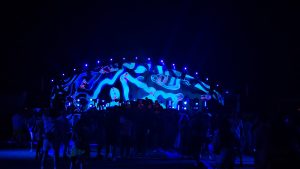
Sound, for Farag, is never static. When referring to the music she utilises she notes that “the most important thing to [her] is that the music is dynamic, a journey,” as translating music into visuals is an embodied, almost performative process that comes alive most vividly in live settings. Even when working with pre-recorded tracks, syncing visuals in real time creates a sensation she likens to “playing” the music herself. By using effects to visually echo drums, melodies or tempo shifts, she allows the music to guide the movement, colour and pace of her imagery. At times, the process is deliberate; at others, it unfolds organically, beginning with a single image that gradually transforms until it aligns with the sound. What matters most is capturing the essence of a song, its energy and emotion, and building a visual narrative that allows audiences to see music as much as hear it.
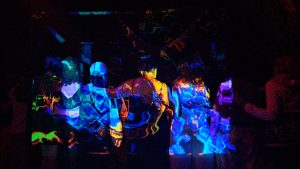
This emphasis on narrative extends into her working process. Projects can take anywhere from a few days to several months and span an eclectic range of events, from concerts and festivals to weddings, installations, and more intimate celebrations. Each requires a different creative lens, pushing Farag to adapt and expand her practice continually. She emphasises that each project is unique and, accordingly, that the creative process differs each time: there are moments when she knows exactly what she wants to use for a song, and others when it becomes “a whole journey of discovery along the way.” By grounding each project in a strong mood board, she prioritises a clear connection to the client, the theme, and the sound, ensuring the visuals serve as an extension of the atmosphere rather than merely a backdrop.
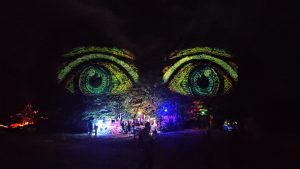
One of the most defining moments of Farag’s career came through her collaboration with Cairokee on their song Roma. The project demanded emotional sensitivity to match the song’s layered narrative, requiring extensive storyboarding and scene-building to bring its shifts in tone and meaning to life. Farag recalls spending “countless days and nights” developing a storyboard and creating distinct scenes for each part of the song, describing the process as “an incredible journey.” She approached the visuals not as a literal illustration, but as an emotional companion to the music, seeking to “translate all the feelings of the song while also not being too literal.” The experience proved both challenging and transformative, allowing her to learn, take creative risks, and produce work she describes as something she is “now very proud of.” Even now, seeing the visuals projected during Cairokee’s concerts remains deeply affecting – an experience she notes still makes her “really emotional” – reinforcing the power of visuals when they become part of the story itself.
Farag describes her work as a different language, one that brings thoughts and feelings to life through moving images, in much the same way music communicates through sound. She frames this act as a privilege, describing it as “expressing thoughts and feelings through moving images, in the same way music does through sound,” a process that allows emotion to be translated rather than merely illustrated. For Farag, visual work extends beyond decoration to become an integral part of the experience itself. This was evident during Enigma’s 25th anniversary, where she worked alongside a dedicated team to bring the event to life. Every visual element was crafted to complement the occasion, enhancing the atmosphere and supporting the celebration in a way that reflected both scale and significance. From her earliest experiments to full-scale live performances, her practice is defined by connection, creativity and an ability to make the intangible visible.