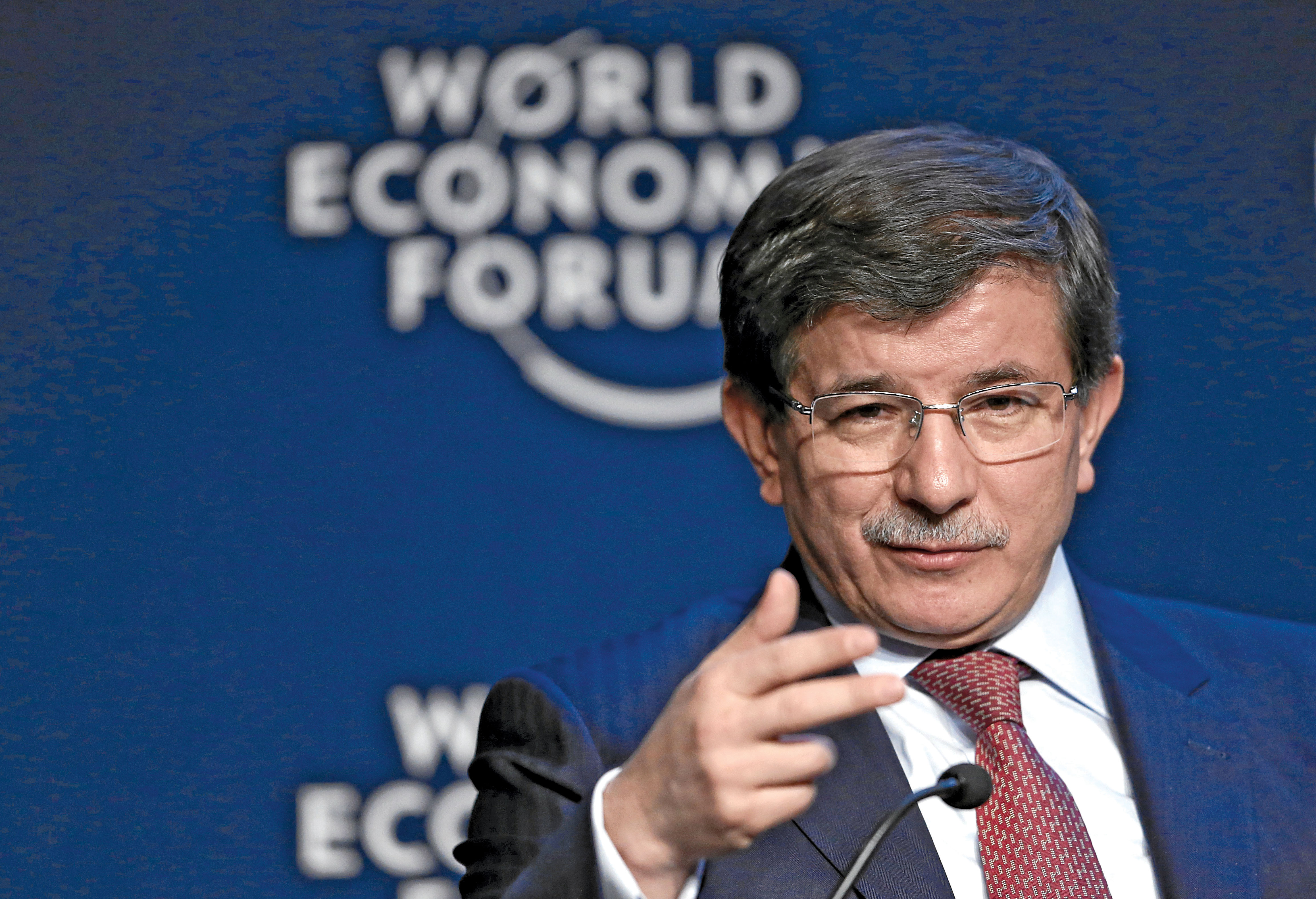
Once again the great and the good gathered for the jam-packed week of the annual World Economic Forum in Davos, and once again history was made, deals were struck and unforgettable moments were created. eniGma’s Editor in Chief, Yasmine Shihata, gives us an inside look at one of the most important gatherings of the year.
Our complex and dynamic world often requires its brightest minds to come together to help navigate through the pressing issues of the day. And this year, over 2,500 business, government, and civil society leaders met at the 44th Annual Meeting of the World Economic Forum whose theme was ‘The Reshaping of the World: Consequences for Society, Politics and Business’. A series of sessions covered diverse topics from gender growth and the global economic outlook to political stability and the plight of Syrian refugees.
Perhaps the most historic moment at the WEF was having Hassan Rouhani, the President of the Islamic Republic of Iran as a main speaker for the first time in 10 years. President Rouhani stressed Iran’s position in the global arena, boldly stating that Iran will no longer accept discrimination from other countries. He said that it is developing nuclear technology for peaceful purposes, as “Iran has never desired a nuclear weapon in the past or one in the future. But we are not willing to give up our peaceful technology.” Rouhani also said that Iran plans to become one of the world’s top 10 economies in the coming years, and intends to develop peaceful relationships with both its neighbors and internationally.
It comes as no surprise that the Middle East once again was high on the WEF agenda with a series of sessions that focused on its current realities as well as future possibilities. At the top of the regional, and often global, agenda was the Syrian crisis, which has left thousands of people dead or injured and millions more forced to flee their homes. In a session entitled “The Humanitarian Crisis in Syria”, it was acknowledged that this is the worst conflict the region has seen since the Iran-Iraq war.
Panel members spoke of their frustration at the lack of compromise within the international community to facilitate humanitarian access to Syrian people everywhere, and chided the absence of leadership by the UN Security Council. It was also argued that the international community had failed to demonstrate sufficient solidarity with countries hosting Syrian refugees. Calls were made to improve international financial support and enhance refugee resettlement opportunities in countries outside the region.
Looking back at the historic events in Tunisia, the epicentre of the Arab Spring three years ago, leadership lessons and future possibilities were discussed in “Fulfilling North Africa’s Promise”. Speakers at this session included Amr Moussa, former Secretary-General of the League of Arab States (2001-2011); Fareed Zakaria, Anchor, Fareed Zakaria – GPS, CNN; Béji Caïd Essebsi, Founder, Nidaa Tounes Party, Tunisia; Abdelilah Benkirane; Chief of Government of Morocco; and Rached Ghannouchi, Leader of Ennahda Party, Tunisia. After decades of corrupt dictatorships and military regimes, there was a rise in mostly Islamist opposition parties and Islam became a strong political force. Amr Moussa explained why he supported the July 30th overthrow of Morsi stating that “dictatorship led to the revolution, which led to Morsy’s illiberal democracy – which is another kind of dictatorship,” said Moussa.
“No group should give itself the right to defy the will of the people, and go beyond elections or election results. The road to coups only leads to catastrophes,” Ghannoushi responded. Béji Caïd Essebsi however, disagreed with his fellow citizen, explaining that, “What happened in Egypt is that there were honest elections that gave a majority to a candidate – but elections are not blank cheques,” he said. Moving to his role in Tunisia, he said that there must be national unity in his nation. Without it, there is no future for the Islamists in Tunisia or anyone for that matter.
A deeper analysis of the unclear future of the region was discussed in “The End Game for the Middle East” session. Among others this topic was covered by Mohammad Javad Zarif, Minister of Foreign Affairs of the Islamic Republic of Iran; Richard N. Haass, President of the Council on Foreign Relations, USA; and Ahmet Davutoglu, Minister of Foreign Affairs of Turkey.
As the attention turned once more to the Syrian crisis, Zarif said that Syria has become a magnet for terrorists. Davutoglu also mentioned the dangers of outsiders going into Syria to protect places they claim are of certain sects or religious groups. “The heritage of Syria belongs to people of many religious traditions – Shia, Sunni and Christian,” he said. Richard N. Haass, said that US diplomacy tended to hinder rather than help earlier in the crisis. “The US articulated ambitious goals, but its actions were modest,” he said.
Hass didn’t see reason for optimism in the future. “We should be prepared to see the current situation get worse in significant ways,” he said. On the other hand, Davutoglu was more positive, as he said, “Our focus must be on support for democratic change and new security arrangements.” Zarif’s conclusions were clear: “We have made some progress…but we are not yet close to an end game in the Middle East.”
This was not the only session in which US actions were brought into question. In a very feisty and surprisingly honest session on “The Future of US Power”, panel members raised the question of whether America had lost touch with the world. Prince Turki al-Faisal, Chairman of the King Faisal Center for Research and Islamic Studies, criticised the United States and the global community for a lack of direction over the Syrian crisis. “The whole world is sitting back and allowing this massacre to take place without taking action,” he said.
Jane Harman, Director, President and Chief Executive Officer at the Woodrow Wilson International Center for Scholars, USA, said that America cannot do it alone. She insisted that the rest of the world must step up too. She said, “In Syria, Russia has to be our partner in the search for peace.” Kenneth Roth, the Executive Director of Human Rights Watch, asked: “Why isn’t the US calling on Putin to persuade Assad to stop targeting civilians?” US Republican Senator John McCain criticised Russia for flying in armed shipments daily to support the Assad regime. He referred to recent reports that 11,000 detainees had been tortured and executed by the regime. “If you believe Bashar Assad is going to agree to a transitional government, I’ve got beachfront property for you in Arizona,” he said.
Yet the Russian minister argued with McCain, stating that the current Syrian government is legitimate and has been recognised by the UN. He shifted the focus on Qatar and criticised them for supporting the rebels. “It’s not a fight for democracy in Syria – it’s a completely different fight,” he said, in what was one of the most heated and raw sessions at the WEF this year.
A number of special addresses were given by world leaders such as Hazem Al Beblawi (then interim Prime Minister of Egypt), David Cameron (Prime Minister of the United Kingdom), and Hassan Rouhani (President of the Islamic Republic of Iran). The overarching theme always included the principles of peace and cooperation but a lot of the speeches also pointed to economic variables that the respective leaders felt were integral to the future of the global economy.
David Cameron told members at the WEF 2014 that the biggest challenge for politicians and business leaders in Europe is how to make a success of globalisation. “It’s time to bring the benefits of globalisation home to ensure the benefits are felt by hard-working people in terms of security, stability and peace of mind,” he said. Cameron remarked on the unease in the relationship between Britain and the EU. “Let’s reform the EU and reform the UK’s relationship with the EU,” he said. “It is doable, deliverable and winnable for Britain to stay in a reformed EU.”
With so much political turmoil in Egypt, interim Prime Minister Hazem Al Beblawi chose to focus on the country’s internal issues, such as the struggling economy, and perceptions of the military. “The real enemy for a market economy… is not the army but the bureaucracy.” El Beblawi said that the main challenge for Egypt is to reconstruct its economy and infrastructure, and to create jobs and go back to being a normal society.
Another pressing topic that was high on the global agenda was the barriers to gender growth and gender equality. The high profile panelists in “Gender-driven Growth” included Carlos Ghosn, Chairman and Chief Executive Officer, Renault-Nissan Alliance; Phumzile Mlambo-Ngcuka, Undersecretary-General and Executive Director, UN Women; Christine Lagarde, Managing Director, International Monetary Fund (IMF); Linda Yueh, Chief Business Correspondent, BBC News; and Sheryl Sandberg, Chief Operating Officer and Member of the Board, Facebook.
Even though she was initially opposed to the idea, Lagarde had a change of heart towards gender quotas, “I soon realised that unless we had targets, if not quotas, there was no way we were going to jump the right step,” said Lagarde. As for Sandberg, she discussed some of the cultural barriers women face. “Leadership is associated with masculine expectations,” she said. “When women do the things that make them leaders, we don’t like them.”
Yet the overriding theme of the World Economic Forum was the importance of international cooperation. This was echoed in sessions that covered education, entrepreneurship, and gender-driven growth. International cooperation was to push the world to a more fair and just place. World leaders agreed that for every country to benefit, the world’s nations must work together in solving common problems.
Of course the driving force behind the WEF is always the hope that productive dialogue between diverse people from around the world in a safe and neutral location like the Swiss town of Davos will help promote positive change with regard to some of the world’s most pressing issues. Once again Professor Schwab and the WEF did their part by placing pressing issues on the agenda. Now the world leaders who attended need to remember the lessons of Davos and follow through…