

As we say goodbye to Ramadan, we look back at some of the noteworthy social dramas that kept us glued to our TV screens throughout the month. This Ramadan TV season will be remembered for the important social issues it brought to light and the stellar performances lead by stars whose brilliant performances had everyone talking about the complex characters they portrayed, and the endless challenges they faced. One show, in particular, Li’bet Newton (Newton’s Game) had audiences holding their breath as this drama with innumerable twists and turns, unveiled. The brilliant performance by eniGma’s February Cover Star, Mohamed Farrag, was a major part of the show’s success. Farrag truly rose to a different level of acting as he conveyed the multiple facets of his character, Mo’nes, the super-religious successful businessman who made it big in the US. We see him turn from a religious figure coming to the help of a fellow Muslim, to a psychologically disturbed man obsessed with making that same married Muslim woman he was helping, become his second wife. enigma’s Hager Alazab sat down for an interview with Farrag to uncover the secrets to his successful embodiment of such a controversial and complex character so well.
What attracted you to Mo’nes’ character when you first read the script?
I didn’t read the script. Actually, there isn’t one time that I worked with Tamer Mohsen that I knew what role I was going to play from the start. Not once! As soon as I get a call from Tamer Mohsen, I know that I want to be in whichever project he is calling me about. But I usually don’t know exactly what I will be working on. When we get to talk about the show, it is usually still in the initiation phase. Mohsen’s school of work is built on the idea that thoughts are flowing constantly and that the kitchen where you cook up the ideas is always open for input; but at the end of the day, there is always a base, a fundamental idea, in the stories he tells. So as an actor, I know the genre, what the story is, and what the main point behind all of it will be. I know things like the characters that I will be surrounded with and which character I will get to play. I also know whether I will have a window of freedom to choose some aspects of my character.

Was Mo’nes a challenging character to play?
For sure. He was one of the hardest characters I have ever had to embody. The most challenging characters I ever played were with Tamer Mohsen. All the characters I did with him weren’t easy at all. Mo’nes is a multilayered character with so many different sides that are all mushed together seamlessly into this one character. And he is a very complex person with so many complications knotted up within him. He has issues that originated when he was a little kid and things that continue to affect him over time and as the show progresses. He’s not a person that is easy to read. Actually, none of the characters in the show are. They are all very complex and multilayered to certain degrees. I consider Mo’nes’ character to be one of the most complicated in the show. He’s definitely on a higher level.
The character you portrayed is so different from anything you’ve done before, including his mannerisms and the way he talks. Did you have to observe someone like him to be able to portray him this well?
No, it wasn’t particularly like that. My problem with Mo’nes’ character was the internal preparation, not the external. When you look at Mo’nes, he’s a lot of things. He’s a brilliant lawyer. He’s a very traditional, Middle Eastern man and he has so many beliefs and ideas in his head that are not necessarily very rational. He’s an important businessman and a government mediator who represents and looks over the Muslim community in America, which is a huge responsibility, due to the cultural differences. And he is responsible for them in the eyes of the American government. He is not a simple man. He’s been living in America for almost 15 years and yet, he is a religious extremist. He is a romantic and a lover and at times, he’s a con artist. Up until now, I have described several different sides of this man. To embody this person with all his different sides and to make him tangible and real was a very hard process. Having to express all those layers and make them come out took so much preparation, and the whole concept just seemed completely preposterous to me at some point. On an external level, we had to think of what his beard was going to look like and how was the audience going to perceive the way he looks? In the end, I knew I had some of what it took to create Mo’nes and I also completely lacked in some other aspects, so I had to complement the skills that I had and practise the ones that I lacked.

Did you know how the show was going to end early in the filming process?
I actually found out how the show ends very recently. In my previous experiences with Mohsen, it was also this way. While filming Bedoon Thekr Asma (Without Mentioning Names), the events of the last episode were completely hidden from us. In Taht Elsaytara (Under Control), I had no idea where Ali Elrouby’s character was going until the 20th or 22nd episodes probably. That was before he completely fell off the deep end. In Haza El Masaa (This Evening), Tamer was asking each of us what we felt comfortable doing and where we saw our characters going. He wasn’t just asking without prior knowledge of what he wanted to write down, he just wanted to get a collective idea of where everybody stood. I don’t think anyone does it like Tamer. Without him, Li’bet Newton wouldn’t exist. Every director has his own aesthetic. I believe that if we had five Tamer Mohsens in the country, the way we create our dramas and series would have changed dramatically and he would definitely take TV to a more elevated place.
How did Covid affect the way the show was filmed and did any changes have to be made to the plot in that extra year the show was postponed?
When we were filming with the intention of the show to be aired in 2020, everybody freed themselves up for it. But Corona made us push the release date to 2021, and we had to film and refilm a lot of things. The problem was that everybody’s schedules clashed and so we had to film and then stop and then do the whole process again. For me, this is the worst thing ever, even if I am filming a sitcom, let alone a show with characters this complicated. It was difficult for the director and a very painful process. The scene where Mona Zaki was giving birth was filmed in both America and Egypt over different periods. But as an audience, you didn’t feel that shift. It took a lot of effort from her to make it seem like it was one shot taken at the same time. And every other cast member was put in this position in one way or another. As actors, we were focused on our characters but the director had to take care of every single detail in the project in terms of acting, decorations, lighting, colours and filming. It was a tough process for the whole cast and crew.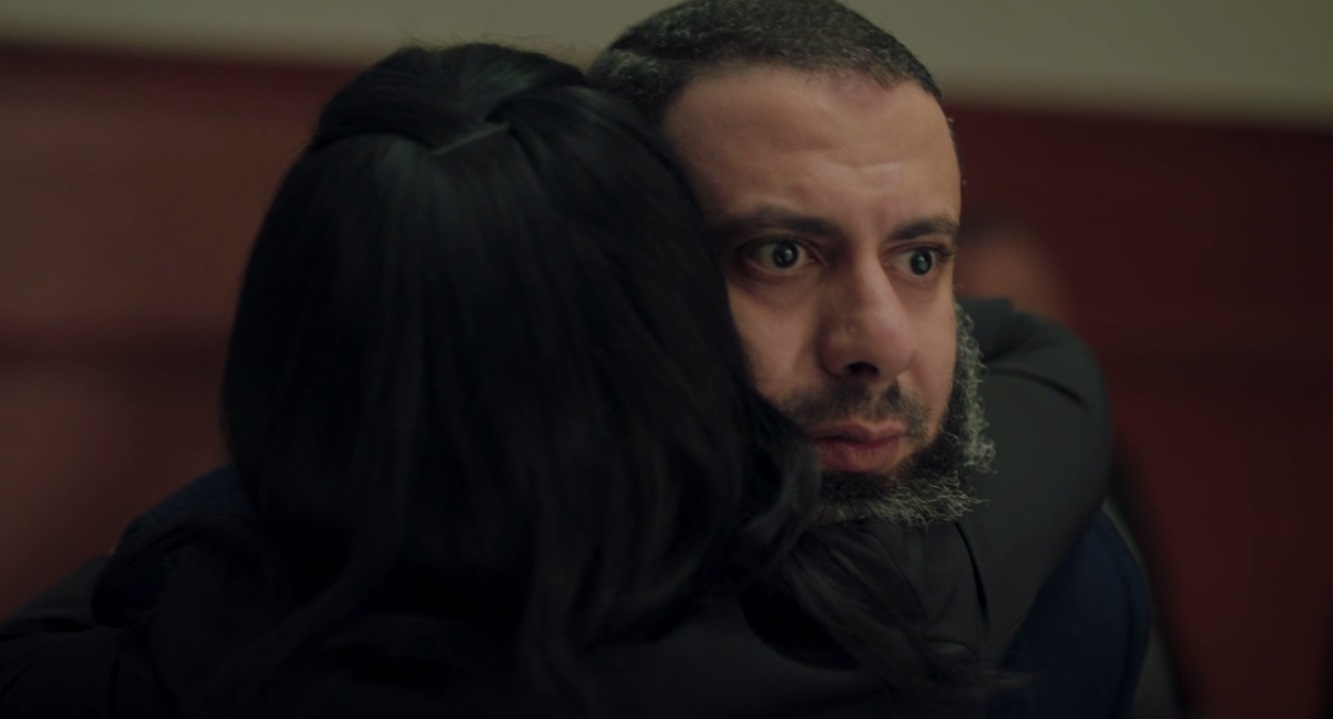
You had to work on Mo’nes in Li’bet Newton and Karim in Ded El Kasr (Unbreakable) simultaneously. Was it tricky to get out of one character and get into the other, especially that the two were polar opposites?
Of course. Thankfully though, while the two series came out together, in reality, when I started filming Ded Elkasr, I was done with almost 80 percent of Li’bet Newton and I only had a little more to film ahead of me. It wasn’t the easiest process, but it wasn’t as hard as it would have been if Li’bet Newton wasn’t wrapping up. I had to snap out of one character to move to the next, which takes a lot of effort. Personally, I find that once the director says cut, my face relaxes and I will go back to myself, but on the inside, I will still be in character. I will still feel like reacting to things the way the character would. So, on the outside, it looks like I have snapped out of it but on the inside, I am still very much in character. It is an internal struggle most of the time. What I do to snap out of it is a mixture of external distractions that eventually make me get out of character. This year was especially challenging because this process had to be much faster as I was playing two characters and I had to get out of Karim’s character to be able to do Mo’nes and vice versa. So, in a way, it was a pain to switch between the two.

Did you expect Li’bet Newton to be a big hit while you were filming?
Yes, to be honest, I expected the show’s success. But I was terrified! I thought I was going to be an epic failure, not the show. I felt like all the people I was acting with were going to shine bright and I wasn’t going to be good enough. We had such a talented cast including Mona Zaki, Mohamed Mamdouh and Sayed Ragab. I think Mo’nes is one of the riskiest characters to embody. There were days when I would just sit on my own in complete fear with overwhelming emotions, and I just wouldn’t know what to do. I was scared and I studied this character a lot.
Why the name Li’bet Newton?
It wasn’t called Li’bet Newton in the beginning, it was called Taqatoa Toroq (Crossroads). The surprising part is that when Tamer Mohsen first came up with the name, he knew it wasn’t going to be called that in the end. I was completely surprised by the new name, yet very impressed with it. It is inspired by Newton’s Third Law of Motion which says that “for every action, there is an equal and opposite reaction” and there lies the entire plot of the show. Every single one of the show’s events is going back and forth in a series of reactions.