

Being the Prime Minister of Lebanon at this challenging time for the Middle East, means tackling very complex issues. But Najib Mikati is no stranger to challenges. For many years he experienced spectacular success growing his private business empire, the M1 Group; a family-owned conglomerate with interests in various sectors including telecom, real estate, aircraft financing, fashion and energy.
Mikati then began his political career in 1998 as Minister of Public Works and Transport, and remained in the post in three consecutive cabinets. In 2000, he was elected for the first time as a Member of the Lebanese Parliament representing Tripoli. In 2005, he was chosen as Prime Minister of a caretaker cabinet after the tragic assassination of Prime Minister Rafic Al Hariri. He remained in this post for three months until parliamentary elections were held.
In January 2011, at another difficult moment in Lebanon’s history, Hezbollah and its allies walked out of Prime Minister Saad Al Hariri’s government, in protest over the United Nations inquiry into Rafic Al Hariri’s assassination. After difficult deliberation all the different factions finally agreed on Mikati as the new Prime Minister of Lebanon. Since then, Mikati has successfully steered Lebanon amidst unparalleled regional instability, including the bloody conflict raging in neighbouring Syria.
eniGma’s Editor-in-Chief Yasmine Shihata interviewed Prime Minister Mikati at the World Economic Forum in Davos to discuss the challenges facing the region and how best to overcome them…

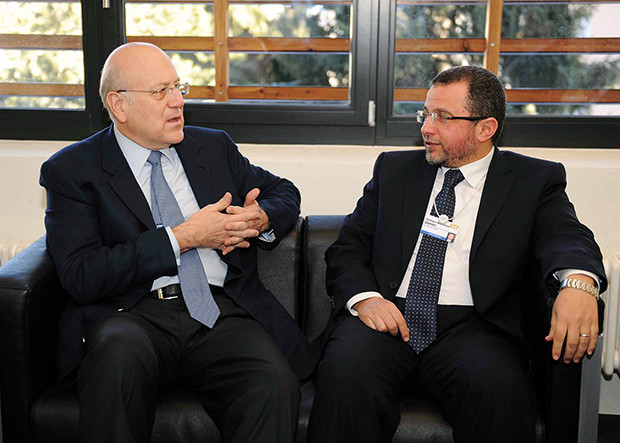
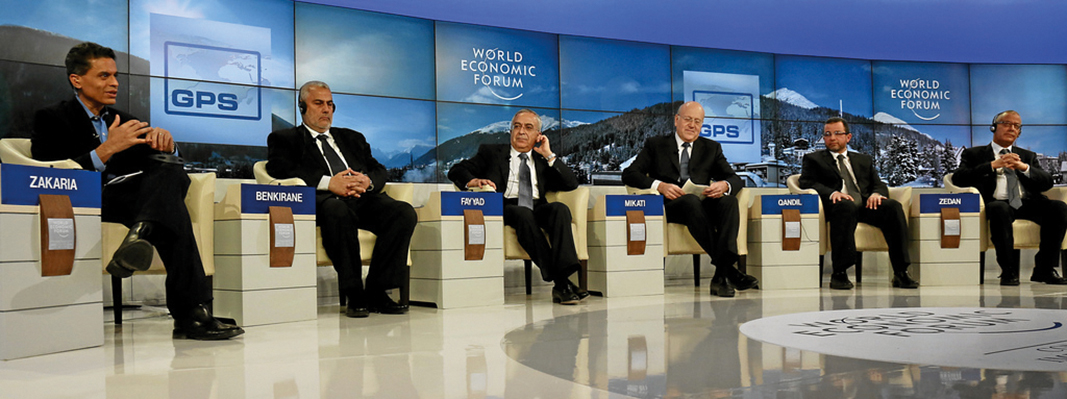
After meeting the Egyptian Prime Minister Hesham Qandil at the World Economic Forum (WEF), what are your thoughts on Egyptian-Lebanese relations?
I had a long meeting with Prime Minister Qandil where we discussed bilateral issues. Our next meeting will be a Lebanese-Egyptian commercial meeting in Beirut to discuss different sectors such as trade, agriculture and industry. We’ll be discussing the possibility of opening the Lebanese market to Egyptian goods and the Egyptian market to Lebanese goods. Egypt is a huge market and this would definitely help the Lebanese economy.
Do you have any concerns over the increasing involvement of religion in politics in Egypt?
It’s not my concern to interfere in an internal political issue in any other country. Personally, religion is very important to me and I am a good practicing Muslim. For me, religion stops at home. If you are a believer, this should be reflected in good behaviour, principles and ethics. At home, I teach my children about religion. But outside my home, religion is about the lifestyle you choose and the way you decide to treat others. That is why it is important not to mix politics and religion especially in the Arab world since it can become a dangerous combination. The harmony of our people is negatively affected when we mix politics and economics with religion. It’s more important today to focus on avoiding disputes and on the employment and welfare of our people and how to improve their standard of living. This should be the most important objective.
As a businessman, what advice can you give the new Arab generation trying to succeed in these turbulent times?
Business people have to think globally and act locally. They need to see how they can create synergy within the Arab world and with the rest of the world, in a way that would benefit our region the most. In the Arab world we have good resources and skilled labour, so we just need to come together by removing the economic boundaries between us. If we did this, Arab countries would be able to cooperate in a manner that would benefit the entire region. This is my appeal to all Arab politicians.
Has this appeal been well received?
Sooner or later it has to appeal to Arab politicians, because as politicians and historians we all know that the borders in the Middle East were created after WWI and many of them are artificial. If we believe in this vision of a free trade zone for our region and we manage to bypass these boundaries, the entire Arab world will benefit.