

In a world where celebrity and talent are often mutually exclusive, where box office bankability is not the same as artistic credibility, Amr Waked is an anomaly. He is an actor – nothing more and nothing less. A true Egyptian talent, who is slowly, steadily making his way onto a powerful world stage. And yet, in doing so, he is finding himself oddly at loggerheads with the Egyptian acting establishment. When Enigma’s Senior Editor Amy Mowafi met with Waked for this interview, he was in the eye of a publicity storm, generated by the Egyptian Actors Union’s accusation that Waked is normalising relations (against legislation) with the State of Israel. Yet we found out that, despite it all, Amr Waked remains above the circus, below the radar and beyond the fray.
Arrogance, ignorance and incompetence. One soon learns to begrudgingly negotiate this ugly trinity of traits in a Warhol-esque landscape, where everyone is vying for their 15 minutes and the world is bursting at the superficial seams with ‘celebrities’. Good news for magazines, bad news for credibility. The trouble is modern day ‘celebrity’ has a nasty habit of crushing, overshadowing, and sometimes (perhaps worst of all) ignoring all talent in its wake. This probably explains why Amr Waked isn’t really all that much of a celebrity. Or so I discovered when I tested public waters with the suggestion that he grace our cover.
Amr Waked? Mention his name in many a circle and the reaction borders on the ambiguous. They definitely know the name; they just can’t quite put a star rating to it. Is he the guy from…from what? Well, how about that hugely controversial Hollywood blockbuster, the one with George Clooney and Matt Damon, the one that was nominated for all sorts of international awards and Oscars. Syriana anyone?
Unfortunately, ‘anyone’ – the Arabic speaking movie-going masses – the ones limited within the stuffy confines of the ‘pile ‘em high and sell ‘em cheap’ Egyptian box office, will likely not have heard of Syriana (2005) – in which the AUC educated Waked plays the silent sullen blue-eyed Egyptian terrorist to devastating effect. So let’s make things a little bit easier, keep things a little more local. Waked has over 17 powerful Arab big screen outings to his name. Want to judge a man by his accolades? Ladies and Gentleman the Cairo Film Festival’s ‘Horus Best Supporting Actor’ award goes to Amr Waked for his portrayal of an unemployed, disillusioned young man driven to terrorism in Dam El Ghazal (Deer Blood) (2005); and while we’re at it, the Alexandria Film Festival award for ‘Best Actor’ also goes to Amr Waked for his electrifying performance in Dail El Samakah (The Fish Tail) (2003); and let’s throw in another best actor gong for his disturbing role in the darkly perverse art house ‘comedy’ Gannat El Shayateen (Fallen Angels Paradise) (1999) and….well you get the point. So what does a man need to do to get a little much-deserved attention around here? (Not that he particularly craves it – but we’ll get to that later.)
Well, the answer, rather appropriately came in the run up to our interview. It turns out you can spend over a decade nurturing your craft, spend months painstakingly painting each one of your multi-faceted big screen characters, do things the credible way, the non ‘celebrity’ way, cutting your thespian teeth in the theatre etc., but all it really takes to illicit the sort of publicity circus that your slapstick cohorts so easily garner, is to…act alongside an Israeli.
Waked’s potentially career-defining role in Between Two Rivers – a four part BBC mini-series (currently being filmed in Tunisia) – explores the inner workings of Saddam Hussein’s family and his relationship with his closest advisers. And it may have slipped under the national radar had the Egyptian Actors Union not taken serious start-a-tantrum offence to Waked working alongside Yigal Naor; the actor of Israeli descent who plays Saddam. Waked plays Saddam’s son-in law, Hussein Kamel al-Majid. So the chairman of the union decided an “investigation” was in order. The media took the bait and had a field day with the drama. A big headline across opposition paper El-Wafd read “Who will hold Amr Waked accountable?”
We’ve not even built him up properly yet, and already we’re trying to tear him down. “We found out Amr Waked was participating in a movie with an Israeli artist and so when he returns from abroad he will be investigated,” Union Chairman Ashraf Zaki told the Associated Press. “The Actors Union here is against normalisation with Israel.” As it turned out, Waked’s “return from abroad” and subsequent investigation, coincidentally coincided with our shoot and interview. In fact, a pivotal part of the investigation process was to take place the same night of our eight-hour shoot. Waked could have cancelled on us, but he is that rare breed of Arab ‘celebrity’: a professional. And yes, he was understandably tense, but he still spent the day making witty references to the situation. When he declined to sport a pair of patent black brogues for one shot, he joked the headline of our article should be “Israelis prevent Waked from wearing shiny shoes.”
The following evening, tucked away in a quiet corner of the Marriott gardens for our interview, Waked is fresh from the fight with no holds barred. Here was a man with a lot on his mind and it was apparently time to unburden…
My innocent enough bubblegum opener about the obvious comparisons between him and Omar Sharif was apparently excuse enough to delve head first into the controversy at hand. “I find it very flattering to be compared to him,” he says in his clear clipped diction, giving each syllable lashings of attention. “Here’s my zoomed out version on the whole BBC series controversy,” he continues abruptly and unexpectedly. “I’m being placed on the same side of an argument with the likes of Omar Sharif and Youssef Chahine [both the internationally renowned actor and director have faced similar tensions with the Egyptian Actors Union during Western big screen forays]. Whenever the subject is brought up by Egyptian press, they immediately bring up those two names. And that to me is super cool. It makes me think ‘wow’.”
So there I was, naively planning to ease gently into the topic, and he gives me the green light to get right in there…so…
Well Amr, about the “controversy”, you told the Arabic press you were unaware the actor playing Saddam would be Israeli and at this stage in the game you were unprepared to breach your contract. Which basically implies that if you’d known, you’d have declined the role…is that really the case?
I might have, I really don’t know. I might have considered not going in order to avoid all those question marks being thrown at me now. If you are asking me if working with him compromised anything, it didn’t. It wasn’t like that at all. When you are clear about the gates you are walking into, why should there be a question if there is an Israeli in the cast or not. And I was clear about these gates; this is a strong British production, sending a very positive message. What if there was an Israeli hairdresser? What am I supposed to do about that?
So this is about fear of retribution?
No, it’s about my reputation, because that is what I sell, and I don’t want to put that into question. I really don’t understand why they are doing this. Do they really think I am a person that has embraced the pains of the Palestinian people with acceptance? Do they really believe what they are writing? It’s very strange.
And of course one has to ask how on earth it’s unacceptable to “normalise” with an Israeli when there’s supposed to be a peace treaty between Egypt and Israel…
Look, let’s not take the subject into a political debate, that’s exactly what we have to avoid. I think it’s a very simple decision taken by a group of people – the union – not to normalise with Israel. And I’m willing to abide by the regulations of the union – I’m not going out there to change the world. All I’m saying is that I have not normalised with Israelis whatsoever. I have simply done a project that has an Israeli actor and that’s a big difference! I did not go and work for an Israeli company or even visit Israel. So where is the normalisation with Israel? This is my view of things.
When, to my surprise, I discovered there was an Israeli actor involved, I was just like, ‘OK, deal with it wisely not emotionally,’ because emotionally I would be very scared of what would happen and run away. But I chose not to be because I am a man who respects his commitments. I was already in Tunisia and I couldn’t have pulled out, even if the union asked me to. It’s a great project, and I am proud to be part of it. And it’s going to tell a beautiful story. And maybe this whole controversy will encourage people to watch the series, and they might just reconcile with my wisdom rather than continue to have these haphazard emotional attacks.
OK, so what about the other side of the controversy, this idea that an Israeli should not have played Saddam Hussein, and the typical Arab tendency to assume there’s a conspiracy behind the production. You’re on the inside, what do you think?
When I first found out, I too had my suspicions. But I felt it was best to reserve judgement and wait and see. I figured my emotional reactions might be immature. And having met the actor, I can say that all notions of a conspiracy have been banished in my mind. I don’t want to turn this whole thing into a flattery of him.
but I think he is a decent guy. At the end of the day, he is not the state or the army of Israel. He is a human being. And that’s one of the main reasons I continued. Even if this guy has an Israeli passport, he did not wear the flag. He did not park his tank on set. It’s just a coincidence, not a conspiracy.
These roles you’re playing could be real stepping stones to international stardom. And what could be better for us as Arabs, than having someone like you – educated, cultured, and talented – make it big. And yet there’s always this negativity from the press, what is that about?
I don’t think a lot of people want to get representation in the West in the first place. That’s the real issue. It’s like they’re saying ‘You’re not allowed to go, we have to question everything.’ Well I’m not buying it. And if that means my ban, well…I read the script, I was very sure of the production’s intentions. I wouldn’t go and play something that’s questionable. This is a story that’s documented, it’s about a certain time in history, and it’s about the facts. And if you’re not convinced, go check those facts.
Yes, but Amr, history itself is terribly subjective, written by the victors and all that…
I say it’s time to change the subject, whenever my name is mentioned this is the only thing people talk about anymore…
Are you asking me to change the subject?
Maybe. It’s just horrible to be questioned like this when you have great intentions. I love my country. I love Egypt.
And Egypt really ought to love Amr back; a man who is pragmatic and poetic in equal measure, he is our own blue-eyed boy (quite literally). And those eyes, let me tell you, are as impossibly sparkling and devastatingly intense as famously promised on screen. But if the Egyptian press should remain resolutely stubborn, that too is fine by him. He has bigger, better things to worry about, namely his new baby son, the mere mention of whom causes Waked to visibly light right up. “He is the biggest thing in my life right now! I have a child! I have a baby boy!” he gushes infectiously. “And yet people are only writing about this stupid controversy. You want to talk about me, talk about my son. He’s gorgeous and he’s changed my world. So they can say whatever they want, nothing they do now can hurt me.”
And if ‘they’ are determined to sully his name, they better be sure they know exactly what they’re saying, because Waked is a man with his eye firmly on the ball. Take this little anecdote as an example: “The first writer who accused me of normalising with Israel was one of the journalists that actually spearheaded the attack against the Cairo International Film Festival for banning Israeli films! This very same journalist once wrote ‘there is no nationality in art’. Then he’s accusing me of normalising? And in that same article he writes that he went to watch an Israeli film in Cannes. And then, two weeks later he’s saying I’m innocent!

Every time he writes, he does it to the beat of different drum, and he just drums away. It’s all ridiculous. What has happened to journalistic ethics? What truth are these people defending? This whole issue is just a discussion starter, it’s a platform to discuss something bigger at a later stage, and we’re all here and we’re all waiting.”
And while we wait, Waked simply continues to do his thing. He’s back on the big screen (a little closer to home this time) at the end of this month in acclaimed director Yousry Nasrallah’s Genenat El Asmak (Fish Gardens), co-starring fellow intellectual Hend Sabry. He’s also in the process of filming the mammoth movie The Passenger, due for release in summer 2008 and reportedly the most expensive Egyptian production ever. It also stars, rather aptly, Omar Sharif himself.
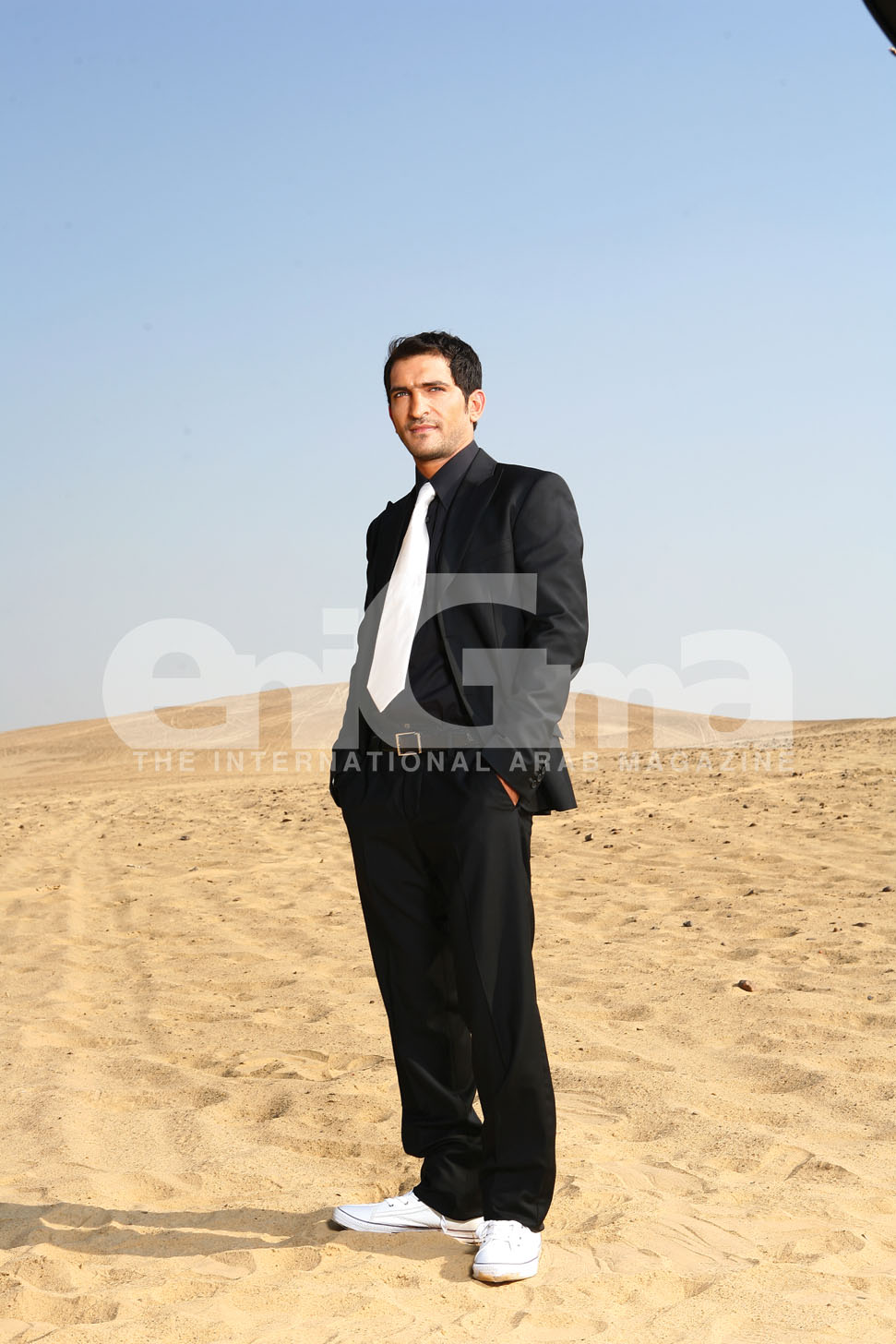
So Waked is a man who deserves to get a little too big for his Converse (his favourite type of footwear), and hog a little limelight for himself. But that’s simply not what he’s about. The sacrifices are too high. Integrity vs. fame? Show him the credibility any day. “I’d prefer to be on the side of the industry that makes people think,” he says, reacting vehemently when I tell him a high profile actress I recently interviewed insisted the Egyptian movie audience had enough problems on their plate, so should be fed a cinematic diet of entertaining fluff. “The most damaging thing that could happen to this country is for people to stop thinking. On a personal level, I don’t think it’s a healthy choice to put the box office first. It will have implications for me tomorrow that I will regret, and I work for tomorrow not today. I don’t want my grandson to come up to me one day and ask, ‘Why did you do this film?’ I don’t want to ever have to explain that we were superficial people. I would rather be alienated from all that.”
Yet that self-imposed alienation – that stubborn desire to “create real art of value”, to choose roles that are controversial and thought-provoking, to act far from the madding crowd – may just cost Amr Waked his shot at ‘celebrity’. Thank God.