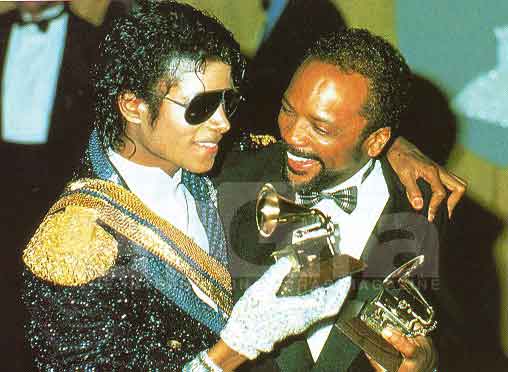
When Enigma’s Senior Editor Amy Mowafi sat down with Quincy Jones – the
greatest living producer of all time – she thought he’d talk about the music. What she got was an explosive inside look at politics, power and the Middle East. And what she learnt was that Quincy the man is a far greater thing than Quincy the legend.
I n this profession, ‘surreal’ comes as standard. I have danced with Ruby in a London hotel suite; competed with a tiger cub for Hend Sabry’s attention and stood on Park Lane arguing with an irate Mido. However nothing comes remotely close to being sandwiched between Harrods boss Mohamed Al Fayed (as he vehemently slates the British royals) and the greatest music producer of all time…Quincy Jones.
It is summertime in London, and Harrods’ top floor Georgian restaurant, where we have gathered for a pre-interview lunch, is awash with a buttery glow. Quincy – in the UK to receive a BBC ‘Jazz Lifetime Achievement Award’ – is in high spirits as he catches up on old times with his long-time friend and confidante Al Fayed. Our ‘quick’ lunch turns leisurely. Three hours later (time flies when you’re privy to a lifetime of legendary superstar stories) we make our way up to Al Fayed’s private offices and settle down to an interview of enchanting proportions.
When writing about a man like Quincy Jones, a man whose personal back-story threads its way through the very fabric of pop music history, it is impossible to know where to start, or more importantly, what to tell. Do we focus on the humanitarian or the music producer; the musician or the movie producer or even the businessman? And if we are to select just one aspect of the story, at which point do we begin? In the biggest black ghetto – in Chicago, Illinois – where he grew up during America’s worst economic depression, or in Paris in the late 50’s where he was studying music composition? Perhaps we should begin at the moment he received an invitation from film director Sidney Lumet and began composing the first of the 33 major motion picture scores he would eventually write. Or maybe our story should start in the mid-sixties when he was named vice-president of Mercury Records, becoming the first African American to hold such a position. Or do we start more recently with the creation of Quincy Jones/David Saltzman Entertainment (QDE), the mammoth production company behind a whole host of blockbuster movies and TV programmes (including The Fresh Prince Of Bel-Air) as well as top selling magazines Vibe and Spin? Of course, we could just delve right into the most iconic of Quincy eras, the heady days working with Michael Jackson…monumental years that saw him produce the Thriller, Off The Wall and Bad albums; albums that collectively sold nearly 200 million copies and made him the most powerful record producer in the industry.
Well, actually, none of the above. We simply let Quincy do what he does best…lead the way. And results are more than a little unexpected…
Days before we meet, Lebanon came under attack, and Quincy – positioning himself way left of the centre and proudly disassociating himself from the home team – is angry…and he’s not afraid to show it. This is how he begins our interview: “Don’t even mention that name in my face,” he says, referring to Bush. “Or Blair either. They’re colonialists. This is the beginning of World War III. Suicide bombers have changed all the rules of war. When you have an enemy that does not mind dying, you have a problem on your hands. And it’s our own fault. If you don’t have anything to live for, you’re prepared to die. America is spending $400 billion on a war and giving Israel $30 billion for underground bombs. It’s sick, it’s insane, and they don’t even know what’s really going on in the world. I’ve been going to the Middle East for 50 years, I know what’s going on down there…Anglo-Iranian oil companies and big Texans taking over and corrupting everything.”
Through his close friend, the powerful American-Palestinian businessman Hani Masri, Quincy has spent years immersed in the political shenanigans of the Middle East, with no agenda except charitable causes. “You have to get inside the bureaucracy and beyond the red tape,” he says. He has dealt with Shimon Perez, befriended the Abdullahs of Jordan, and wherever possible, made a difference. “If you got people on their feet, if you gave them a good life, there wouldn’t be any suicide bombers,” he says.
So I might want music industry stories. I might want to know what it feels like to have produced some of the greatest albums of all time…to have worked with Ray Charles, Peggy Lee, Ella Fitzgerald, Frank Sinatra and of course Michael Jackson; to have 70 Grammy nominations under your famous belt, and to have been there at the inception of the Thriller album. I might want to ask what it’s like to be the catalyst behind the world-domination of black music – to be a power player in the hyperbolic history of pop music – a man without whom today’s generation of über-stars, like P. Diddy, Pharrell Williams and Kanye West, might never have had their moment in the spotlight. But, right now, Quincy has little desire to talk about the music. There are far more important issues to attend to. Namely the state of the world…
Quincy is as known for his social activism as he is for the music. “The arts and entertainment bring people together. They allow the ties between us to flourish and grow, even during times when differences between governments arise,” he says. It’s a journey that began in the 60’s with his vocal support of Martin Luther King. His charitable efforts became globally known when he produced the historic charity single We Are The World. More recently, Quincy lends his time to causes in Africa and the Middle East. “I first went to the Middle East in the 50’s and that’s where it all started,” he explains. Well, he says ‘went’, but what he’s really referring to is his celebrated 1956 tour of the Middle East and South America as Dizzy Gillespie’s music director. Decades later he was approached by Hani Masri, and along with an Israeli named Yuri Savir, created the ‘We Are The Future’ foundation; setting up child centres in some of the most troubled cities in the Arab region, including Nablus and Kabul. The foundation also provides services in education, health, water purification, nutrition, information

technology, sports and the arts. In 2004, nearly 20 years after he gathered music greats together to record We Are The World to benefit Africa’s hungry, he worked his magic once again, this time bringing the next generation of celebrities to Rome at the Circus Maximus for a ‘We Are The Future’ concert benefiting war-zone children. The mere mention of the event sends Quincy into a political diatribe. “First, we went to Queen Rania to talk about doing the concert at the Red Sea, but it was too dangerous,” he says. “We also considered Jerusalem, but that’s a joke.” And when he says ‘joke’, he’s no longer talking about event logistics, but millennia worth of conflict. “They’re talking about peace, but there’s never been peace there. Arafat turned down Clinton and the Saudis’ solution and then they called in the animal Sharon, which of course didn’t work.” Rome, however, did work. With over 750,000 people in attendance, the event featured musical superstars from across the globe and proved “that love sings louder than hate”.
Which is all terribly commendable, really. But, I still desperately want to talk about the music. “On a lighter note…” I awkwardly begin. “There is no lighter note,” he interrupts. “This is the most important thing, this is number one.” And before I have a chance to continue with my superficial questions, we are immersed in world politics and what he believes is an ensuing global backlash against the USA. “Look at China and Russia,” he says “They’re not taking anything from America. This is the end, you wait and see. As for Emirates, they ain’t playing. When was the last time you went to Dubai? It’s incredible what they’re doing.”
Dubai? How are we talking about Dubai? But Dubai it is, and although I’m not quite sure what the moral of the story is, he tells it so passionately that one gets swept along. Besides, I’ve now given up any pretence of directing the interview. “This year alone I’ve travelled over 400,000 miles in the Middle East with Hani,” he says. “And Dubai, wow, it blows you away. I’m involved in three big property developments there.”
But surely the Arabs should be spending all their oil riches on something a little more worthwhile? (This is my feeble attempt at a direct question. It is dismissed.) “Why?” he snaps back. “What’s wrong with investing in these properties? When the oil runs out in 10 years what are they supposed to do? Tourism, that’s what it’s about. They now have the biggest hotels with the highest prices in the world, all at 92% capacity; just like that, in only eight years! They know what they’re doing kiddo.”
He calls me ‘kiddo’. I might be completely incapable of managing the conversation, but at least I feel like I’m in a movie. And I’m now discussing the state of the world with a man who has the proven power to make tangible changes in the world. In 1999 Quincy joined fellow musicians Bono and Bob Geldof in soliciting the world’s major economic powers to eliminate debts owed by Third World countries. “I got Colin Powell and Clinton aboard. We made the American government spend $100 million; just two raggedy old Irish rockers and a brother from Chicago. And you realise, ok, so that’s how it works.”
I have committed reams of Quincy notes to memory, but all are proving rather useless now. The best I can come up with is to ask if he spends much time in Egypt, and immediately hate myself for the inanity. But what I get right back is a story to rival the best of Dan Brown – (full of names which it’s really best I don’t mention) – brimming with AK47 guns, casinos (in unlikely locations) and corruption; big money deals between high-profile Arabs and loathed Israelis and enough weaponry to make Bush giddy. Things, which in Quincy’s own words, “you ain’t gonna see on CNN or Al Jazeera.” And the reason he found all this out? The reason he was in Egypt? He wanted to build his dream L.A. home out of the same material used to create the Pyramids. Which guns aside, is a rather fascinating insight into the lifestyles of the rich and famous in and of itself. But there’s no time to dwell, there’s more political prose to come: “It’s amazing what’s going on in the Middle East that no one knows about because these big news channels just tell people what they want to hear. But I’m on the inside, I know all the record companies and TV guys in Qatar, Kuwait and Dubai, so I know what’s really happening. I just met with the Crown Prince of Abu Dhabi, we talked for about three hours; we all have a network together.” And so it goes, more and more thrilling by the minute and less and less suitable for publication by the second. I no longer want to talk about the music, I’m enthralled, but I need to scavenge a few quotes of use for a Quincy Jones profile. “Let’s talk about you,” I venture reluctantly…
So we do eventually find our way to the music; I do eventually get my ‘usable’ quotes. But one should be careful what one wishes for…When I listened back to the tape, the hours worth of riveting recorded conversation; it was the reply to that one request “let’s talk about you,” that finally decided the angle of this article for me. Where do you start when profiling a man like Quincy Jones? What do you talk about? Well, you try your best to find out what really makes the man, what is most important to the man. And if you can understand how the man defines himself, you probably have your answer. Yes, the music is magical and iconic, and yes, the music made the legend, but it certainly hasn’t made the man. “Let’s talk about you,” I venture…
“This is me kiddo. This is me. Remember what Tolstoy said, ‘My piece of bread only belongs to me when I know that everyone else has a share, and that no one starves while I eat.’”